A travelogue · Calanoa, Río Amazonas, Colombia · June 28 – July 4, 2026
told by Diana & Colin · photographs by both of them
Why We Went
It started with a birthday. When Diana decided what she wanted was to go to Amazonas — to the river mouth where her parents had been married, where they had worked as doctors — the first thing Colin did was go to Best Buy. The boys came along and were bought a decoy: a pile of Legos. WALL-E got assembled and watched that same week. The actual mission was a 100–400mm lens.
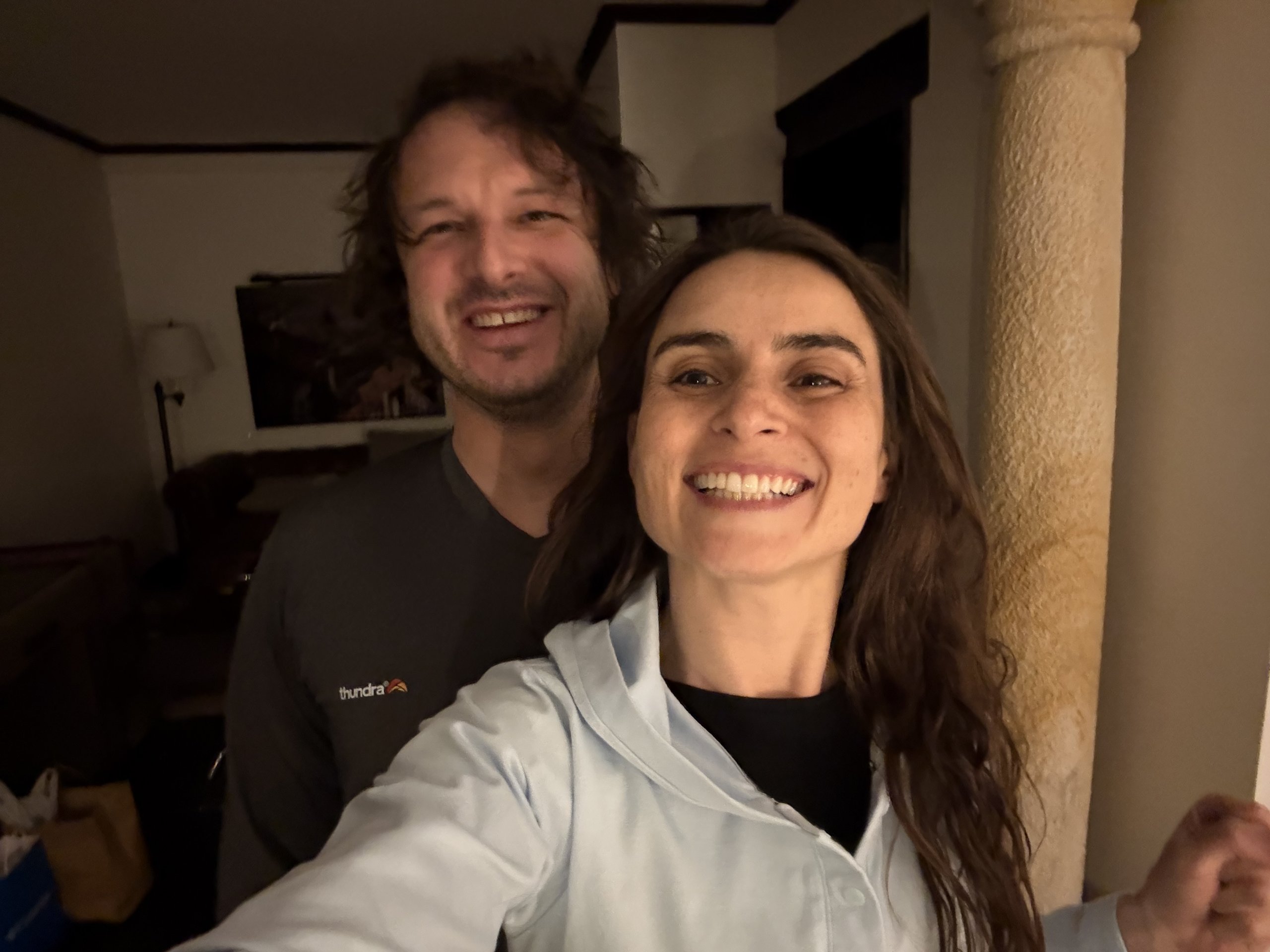
Bogotá, the night before — packed and ridiculous with excitement.
There was an inheritance behind the lens, too. A friend, Francisco, had shown us at Punta Brava what it looks like to relate to an overwhelming amount of nature through a camera — constantly looking, observing more and more deeply, leaving nothing behind but footprints. That was the intention we packed: go to the most alive place on Earth and pay attention to it.
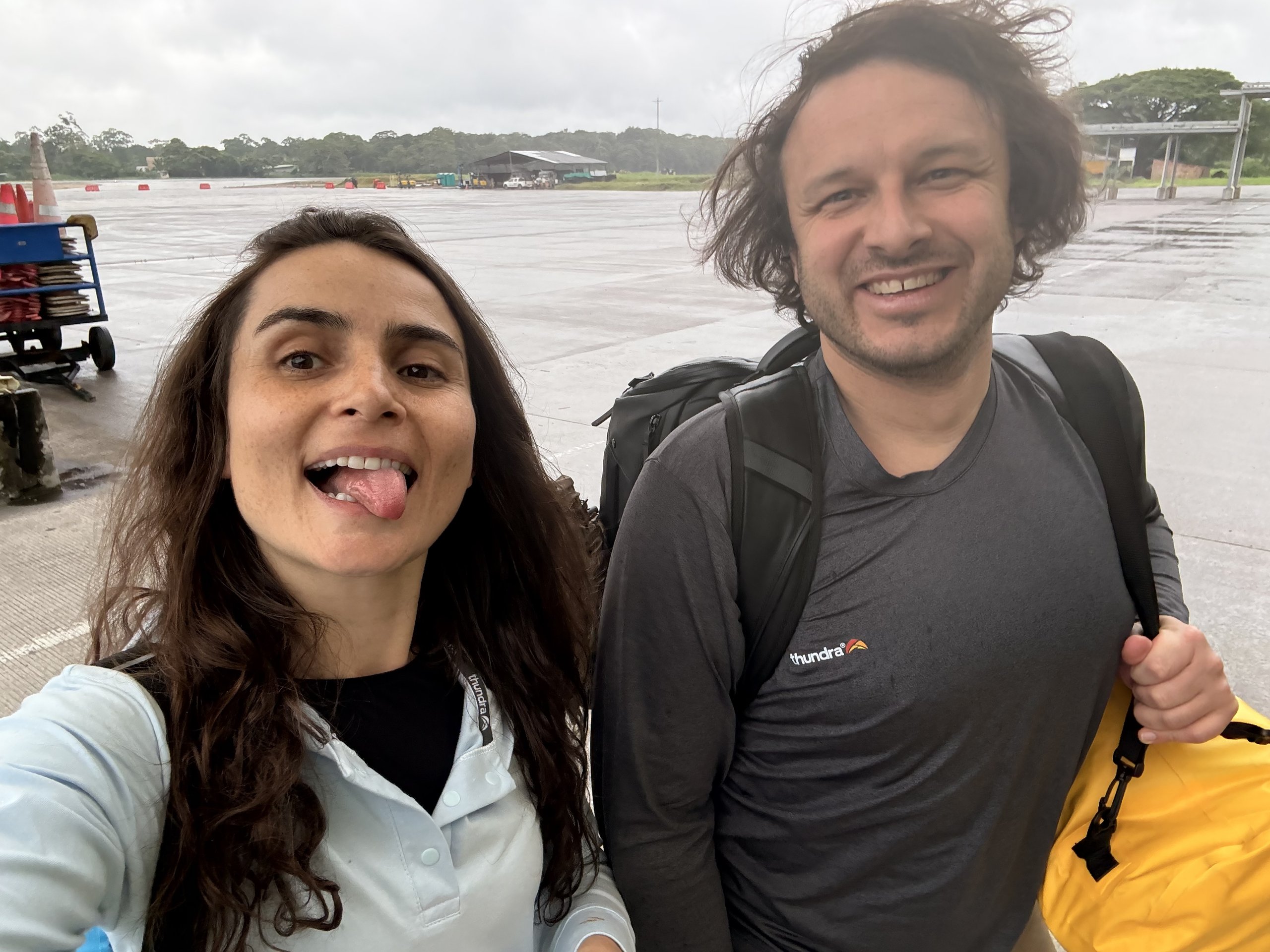
Arrival in the rain, Leticia tarmac.
The Way Is Water
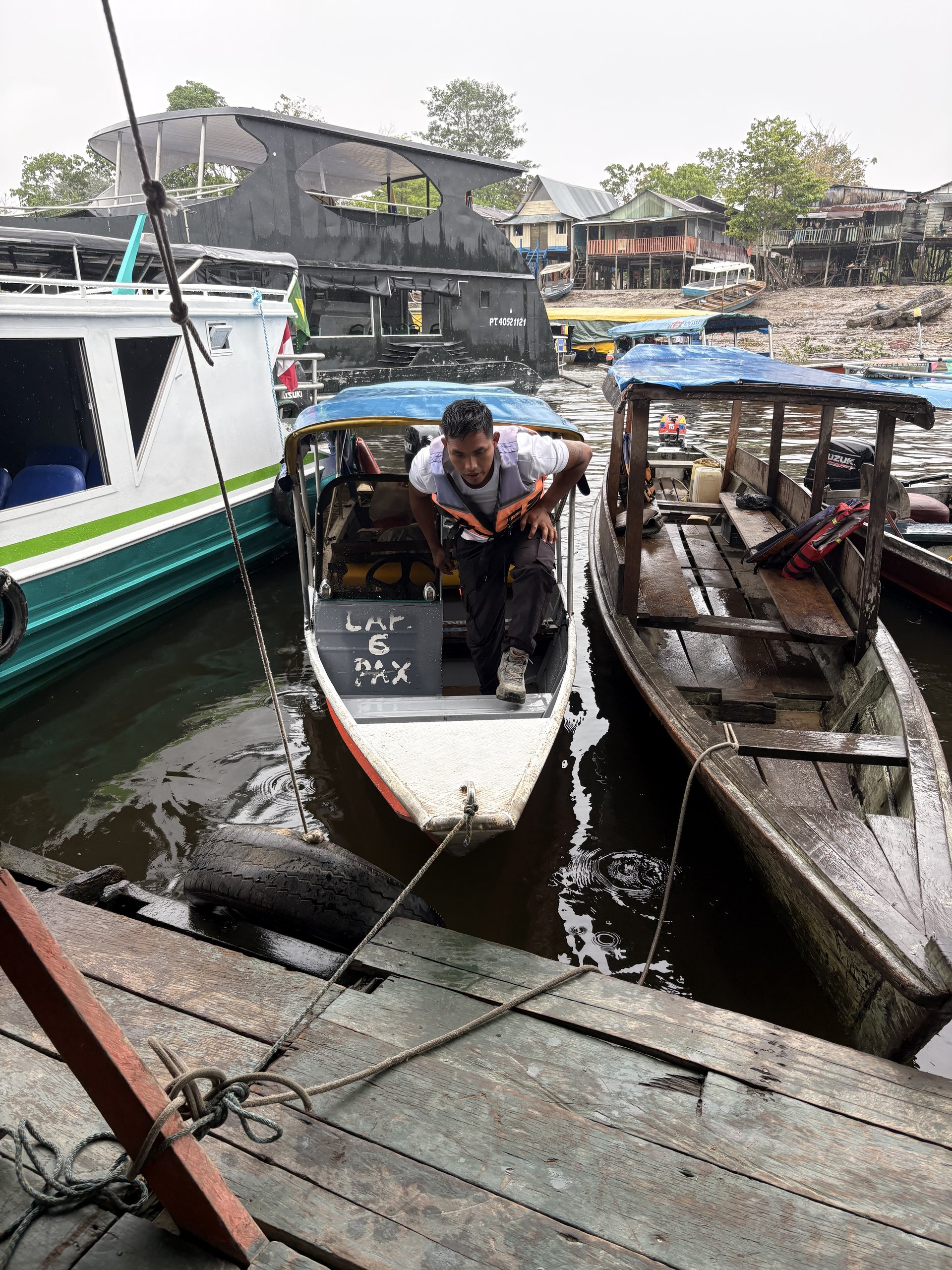
Calanoa sits about an hour and a half by boat west of Leticia, and Leticia — a small town with an airport and a flight to Bogotá — is the last place that can pretend to be a city. Out here the understatement would be that there are no roads. The river is the road. The way is water, wherever you're going.
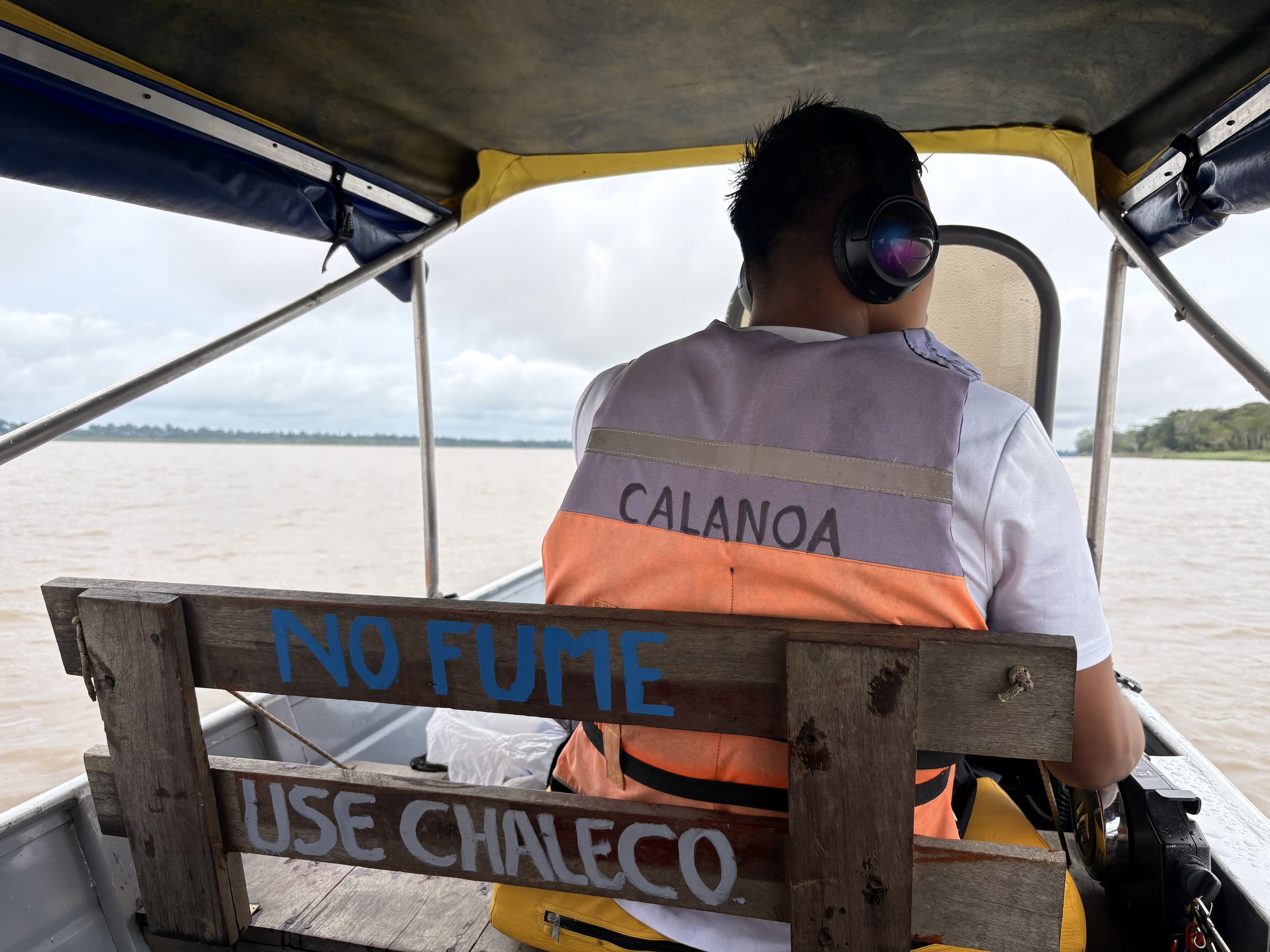
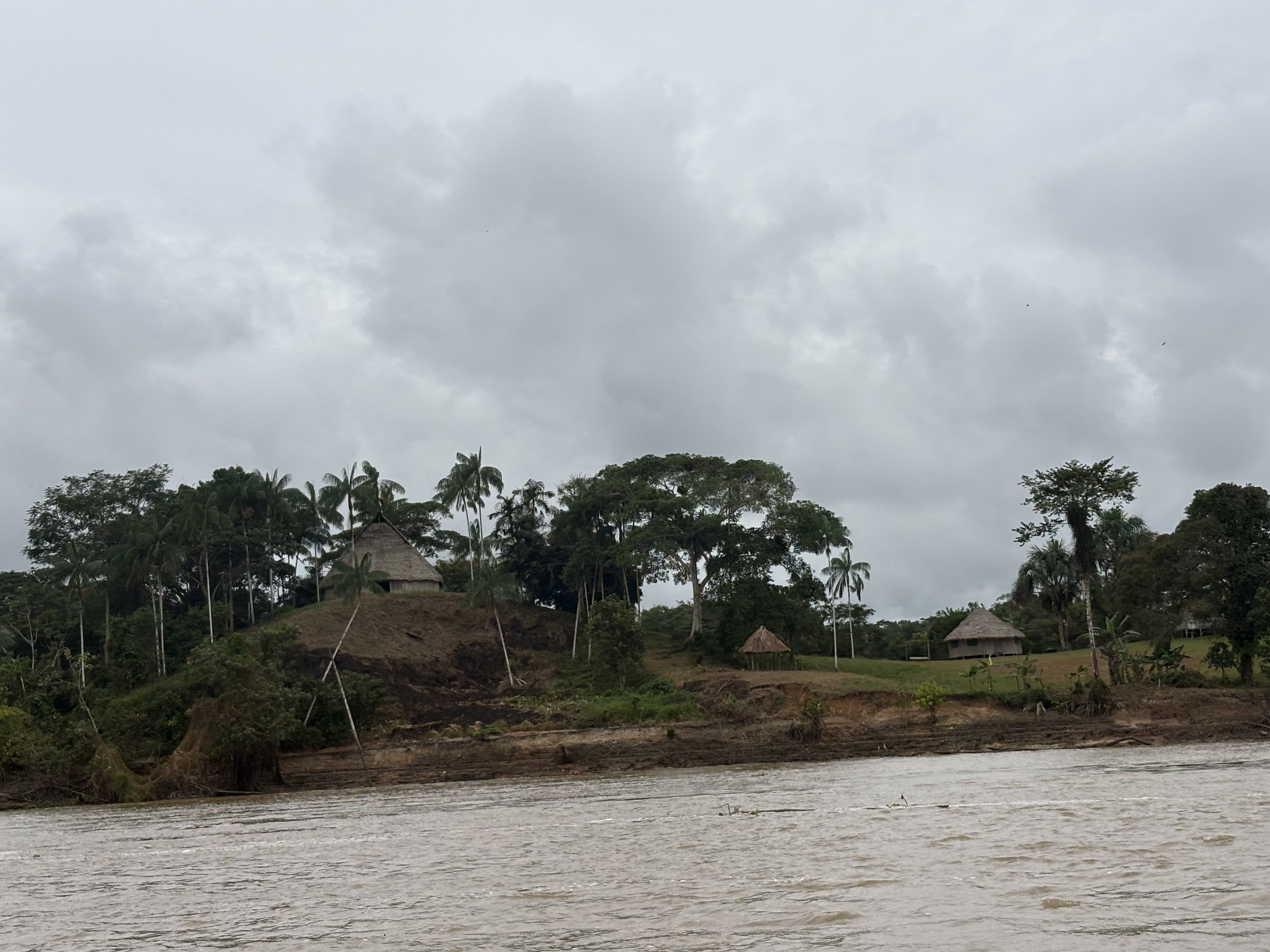
Crossing the Amazon: no fume, use chaleco.A river village from the water.
And most places, you're not going. The Amazon in early July is in its second month of descent, dropping something like ten meters between seasons, and it is not a river you want to be in. It's not polluted — it's just mud, moving very fast, full of trees and branches from a thousand tributaries, some floating, some stuck and resisting the current, which means there's a lot down there. A fisherman fell in and died the week before we arrived. People here fish from the skimpiest canoes imaginable.
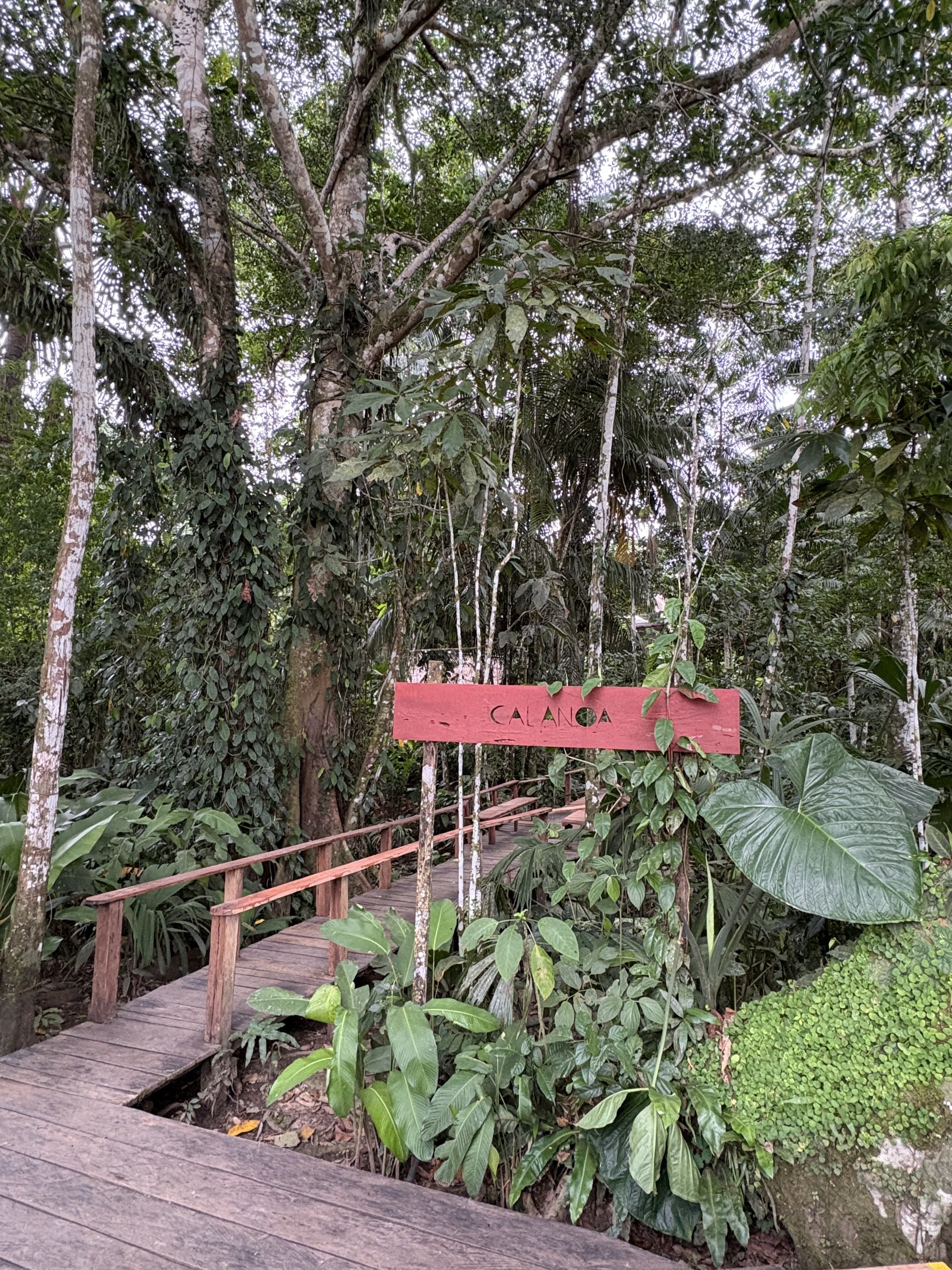
The footbridge into Calanoa.
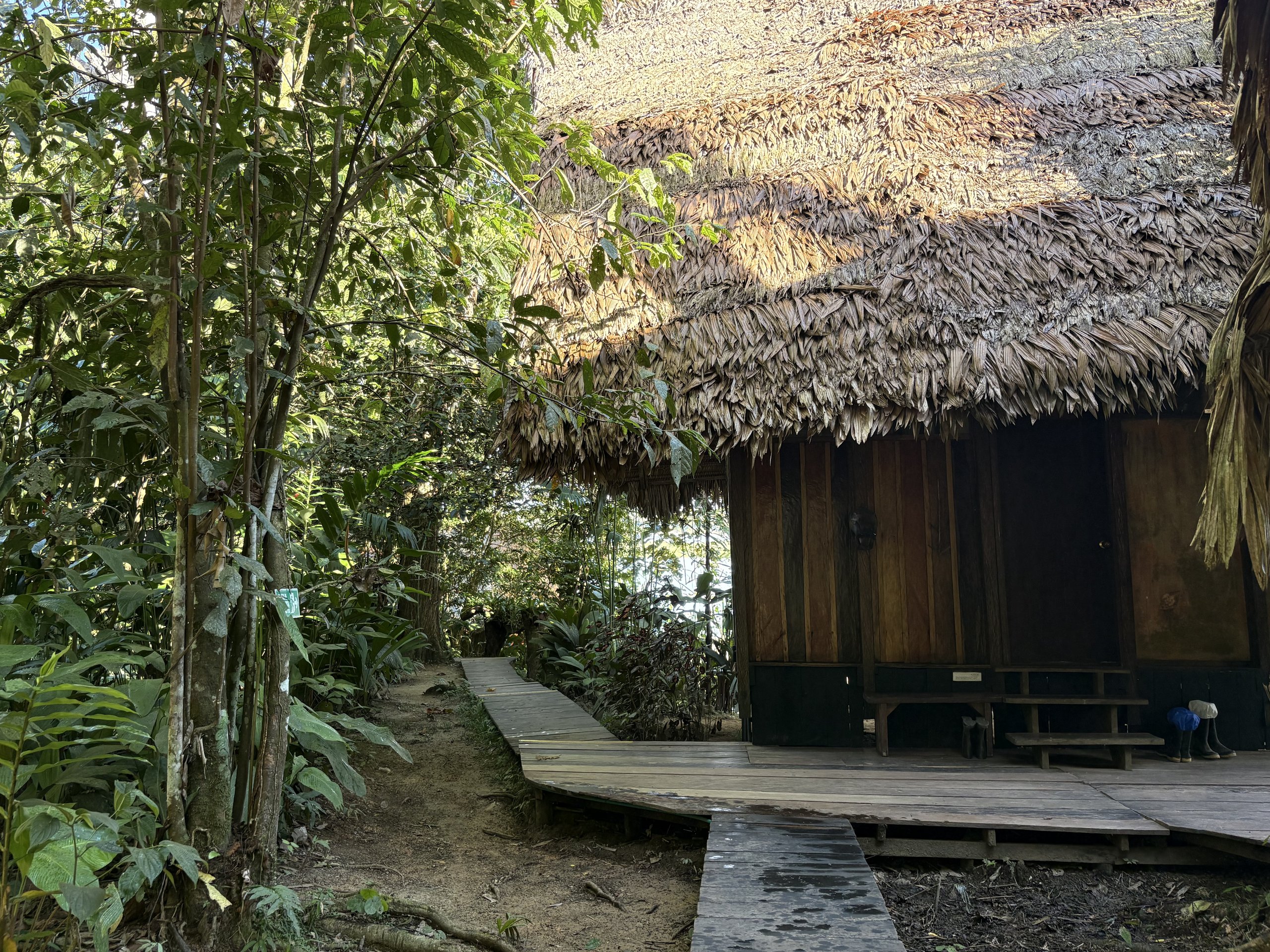
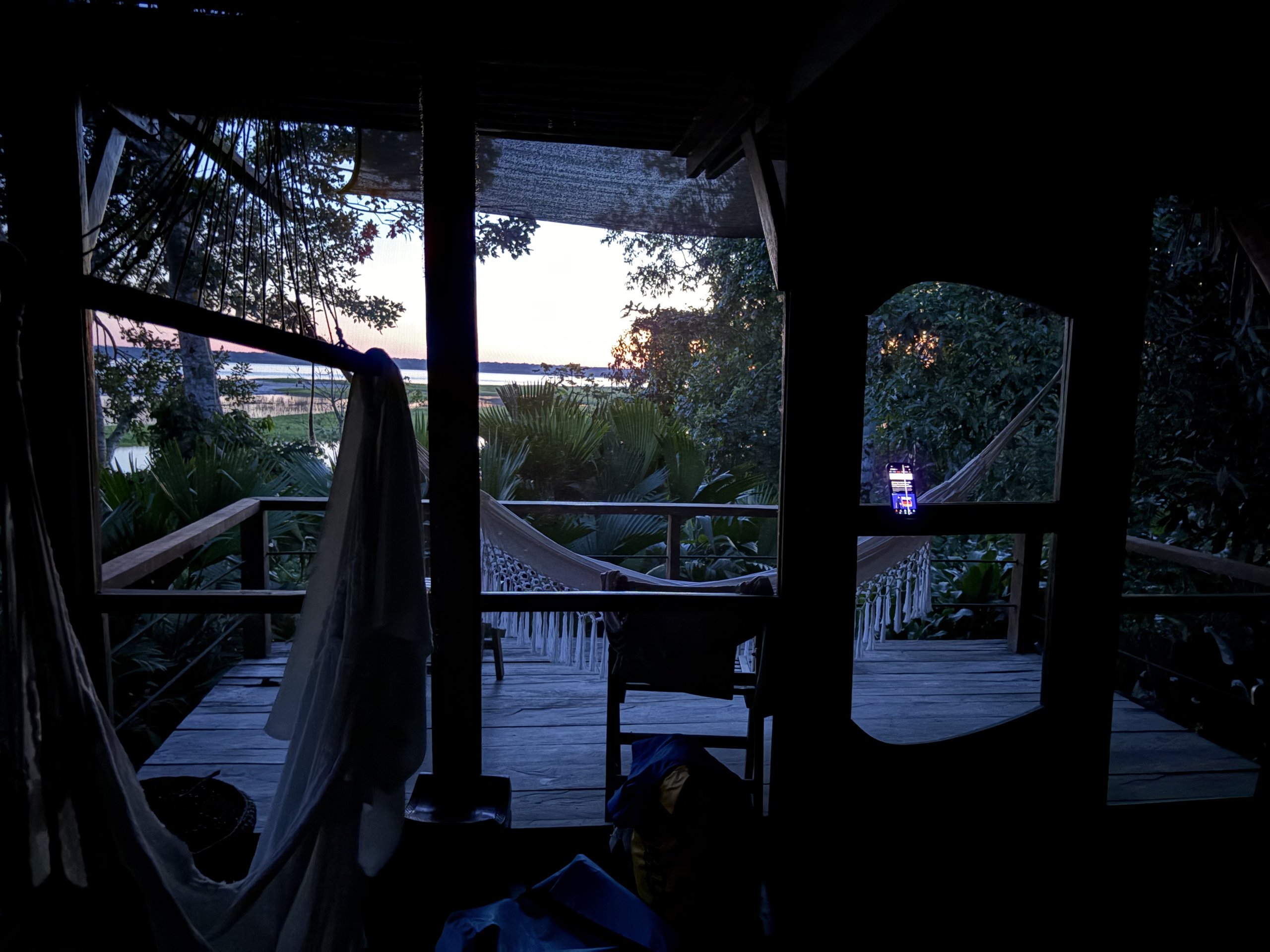
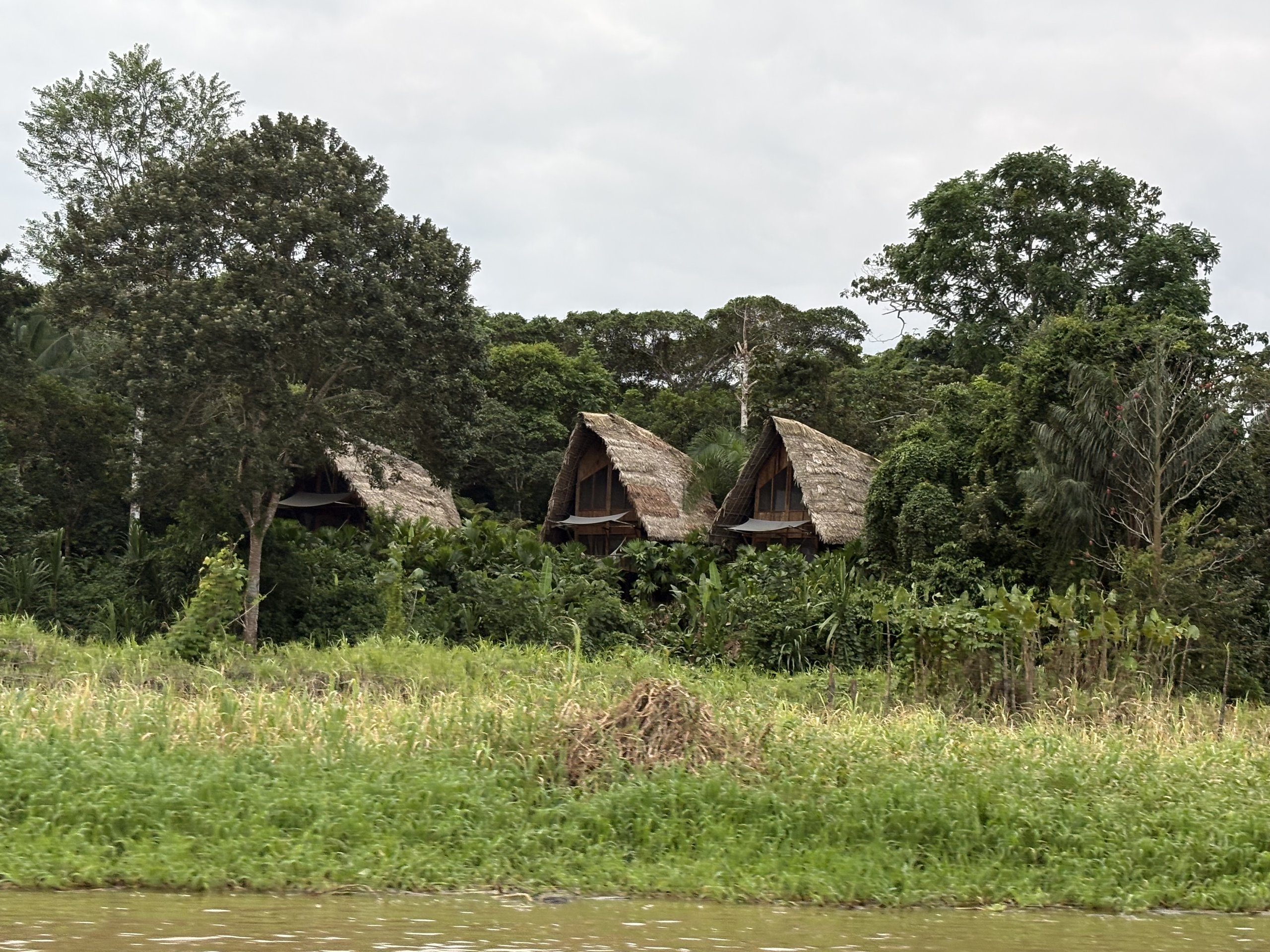
The lodge itself was built and is owned by a photographer who was a friend of Diana's father, and it shows: he built it in one of the most photogenic places possible for wildlife. Calanoa's particular bit of magic is intermediation — between guests who expect coffee on the table every morning (the ladies in the kitchen run a tight ship; the coffee is very good) and a place that has entirely different ideas about schedules. There is no hotel building, really. There are cabins, a platform, some walls. Sometimes no door. It isn't that they couldn't put a screen up; it's that a cockroach can get in anyway, and in that humidity the cost of maintaining a screen is enormous. You build the platform — being off the ground matters, for snakes — and you keep it minimal, and the forest does what it does.
A cabin, a boardwalk, boots drying: the whole architecture.Platform, walls, hammock, lantern. Sometimes no door.
The Village With No Police
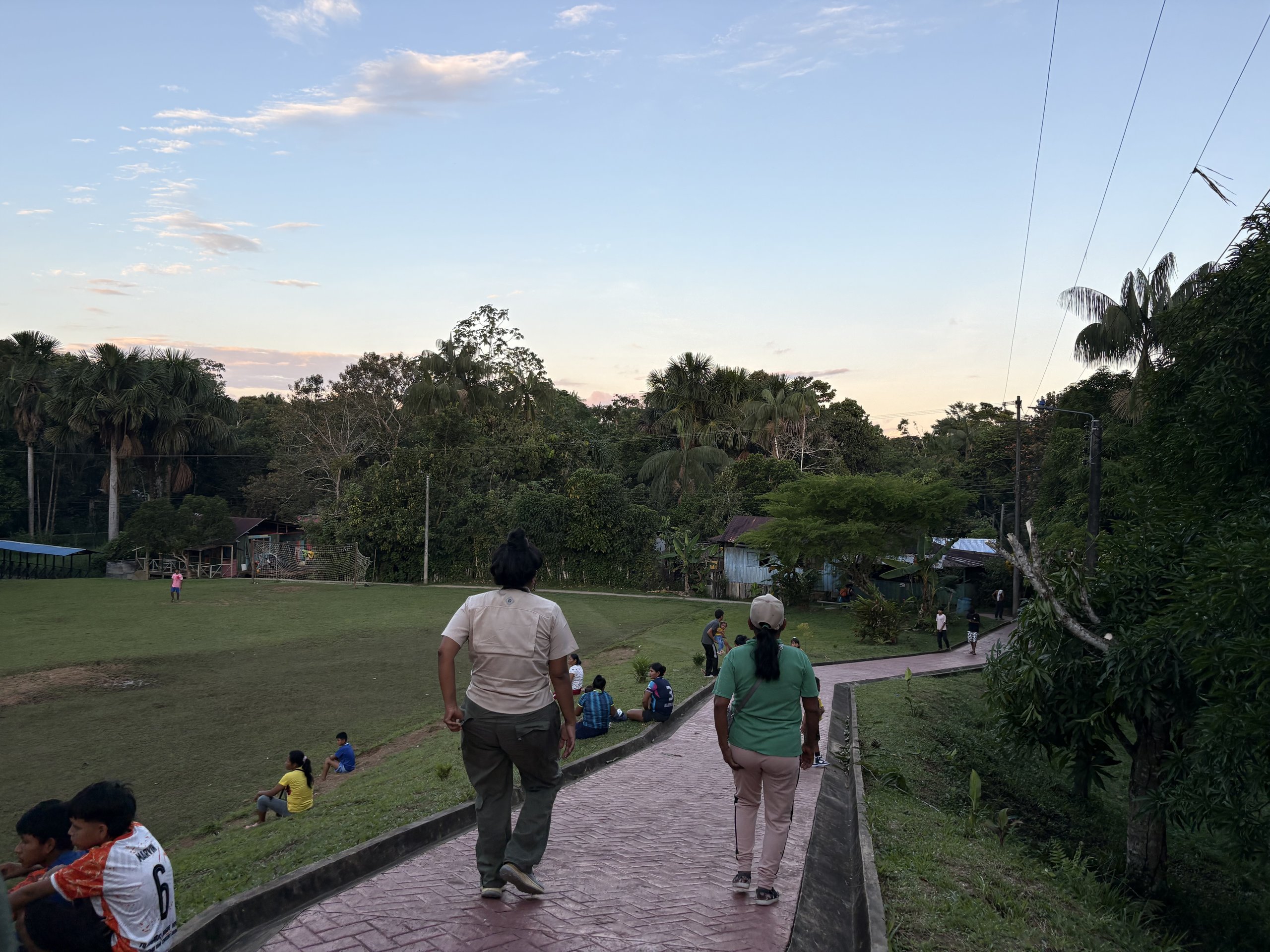
On the first night's village tour we learned that the police station had been destroyed by FARC, and the police killed. Afterward, the Ticuna asked for the police not to be replaced — and FARC, for its own reasons, stopped seeing the town as a point on its map. It was a place where the guerrillas could be cornered between jungle and river, cut off; bad territory. So they withdrew. And so did the state. What's remarkable, and worth saying out loud, is that neither authority is here. There are places on the river where humans live; there are tribes with internal norms; there are eco-lodges that intermediate between tribal law and the expectations of people who appear on, and in, White Lotus. Like our neighbors.
Mocagua paints its own institutions.
Is this disorder? Is it anarchy? Not at all. The system here is Ticuna, and it is unbelievably settled. There is tribal law. The dudes are very relaxed. Kids run around on iPhones. Diana pointed out that much of this rests on the Colombian constitution of 1991 — the great amendment that came out of the peace negotiation with M-19 — which recognizes indigenous communities as sovereign over their resguardos, with complete decision power over their lives and their lands. The state made space for what was already true.
We kept coming back to García Márquez. Here comes Apolinar Moscote, the one policeman of Macondo, setting himself up as a petty dictator, fixing votes, handing out paint. That's what a police station is, out here: a tin-pot dictatorship of one random cop. There's no way for it to become a system, so it can't succeed. What succeeds is older and quieter and already in place.
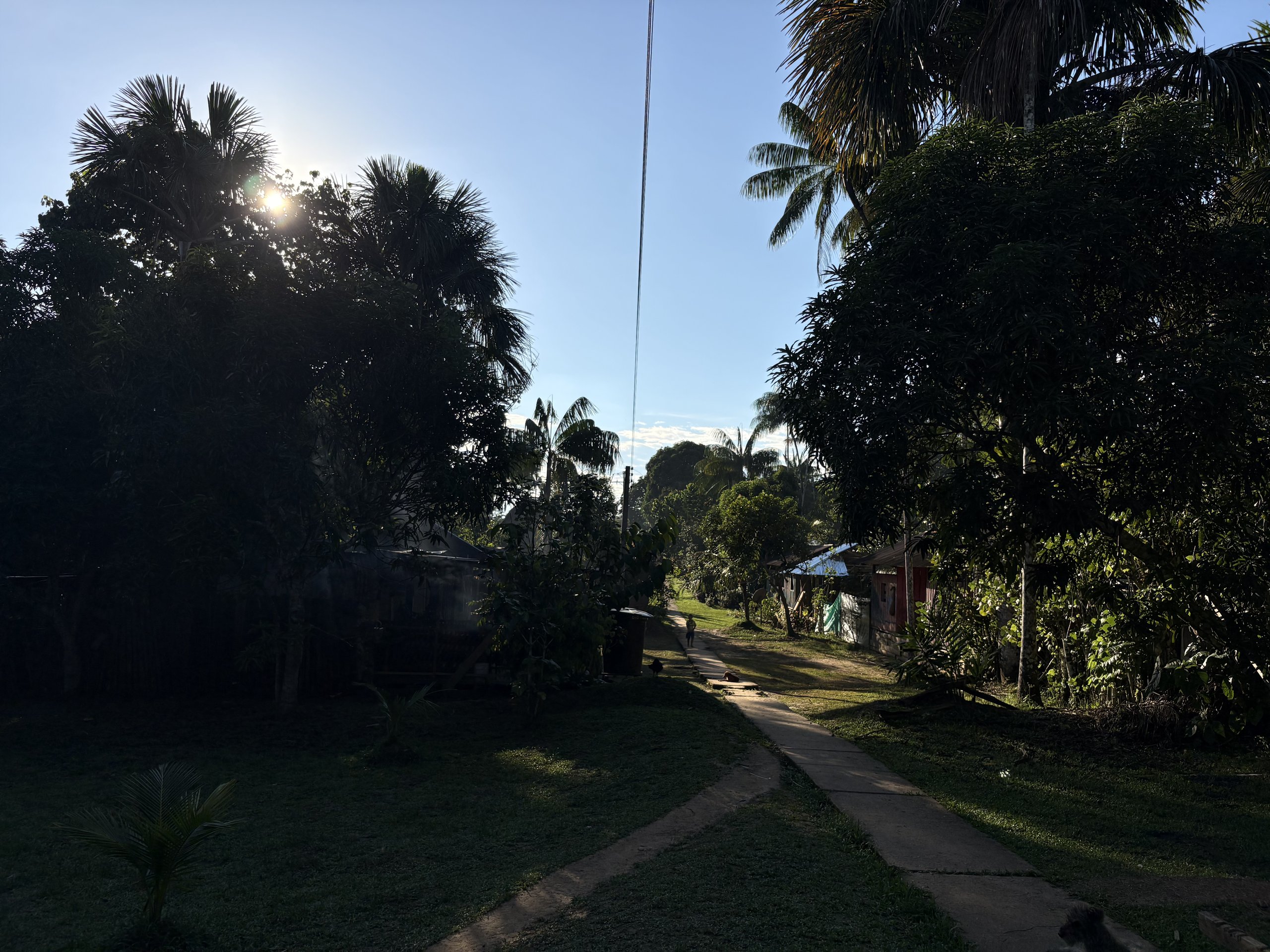
Dusk, soccer, nobody in charge and everything in order.
Piranha
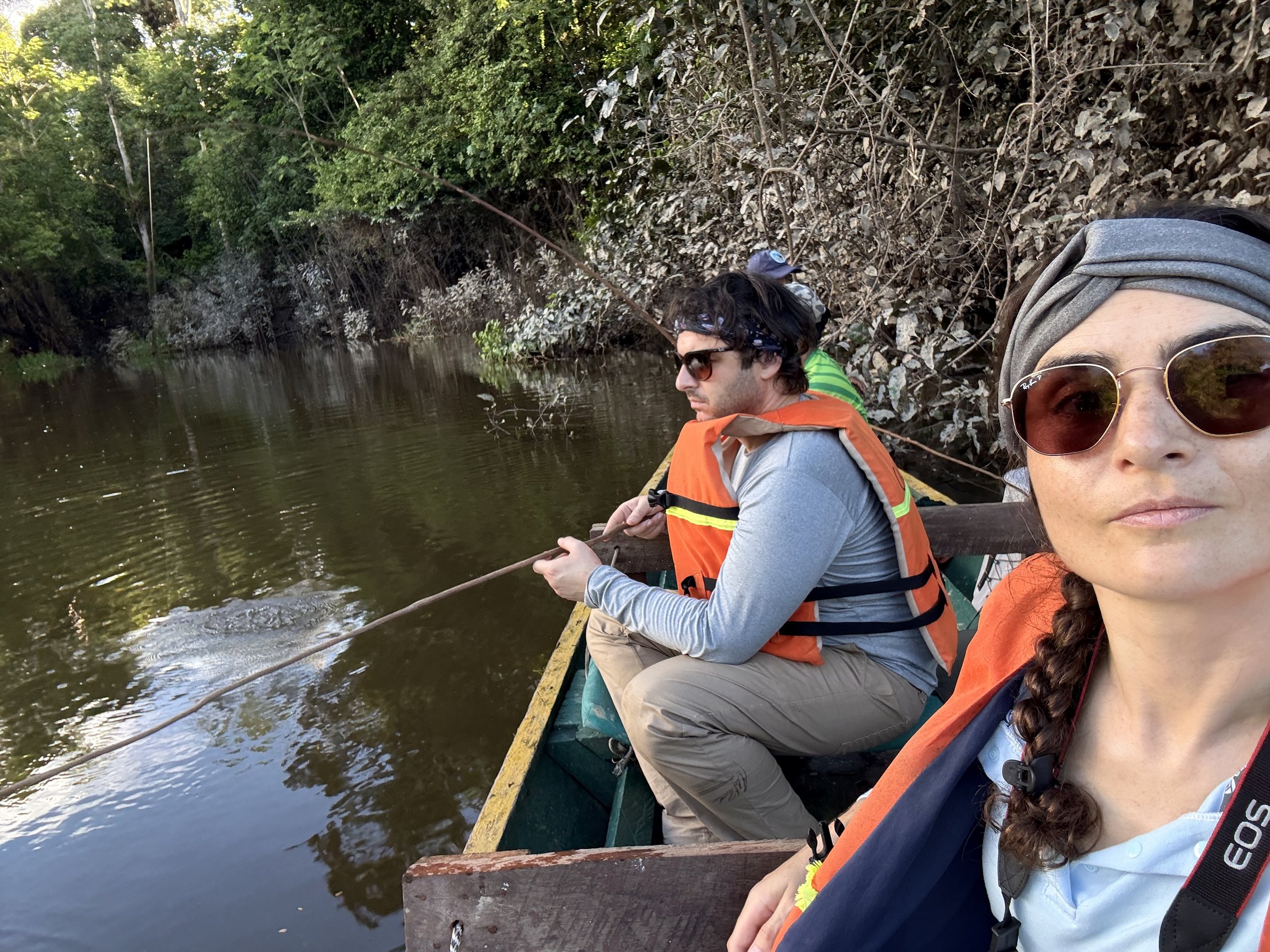
A husband and wife took us fishing in a little cove — branches not yet exposed by the falling river, which is exactly where the piranha live. The mechanics are simple and absurd: they cut fresh fish for bait, you drop the hook in, and you have seconds. The bait will not last. The only question is whether you set the hook through a lip and swing the fish into the boat before it's stripped.
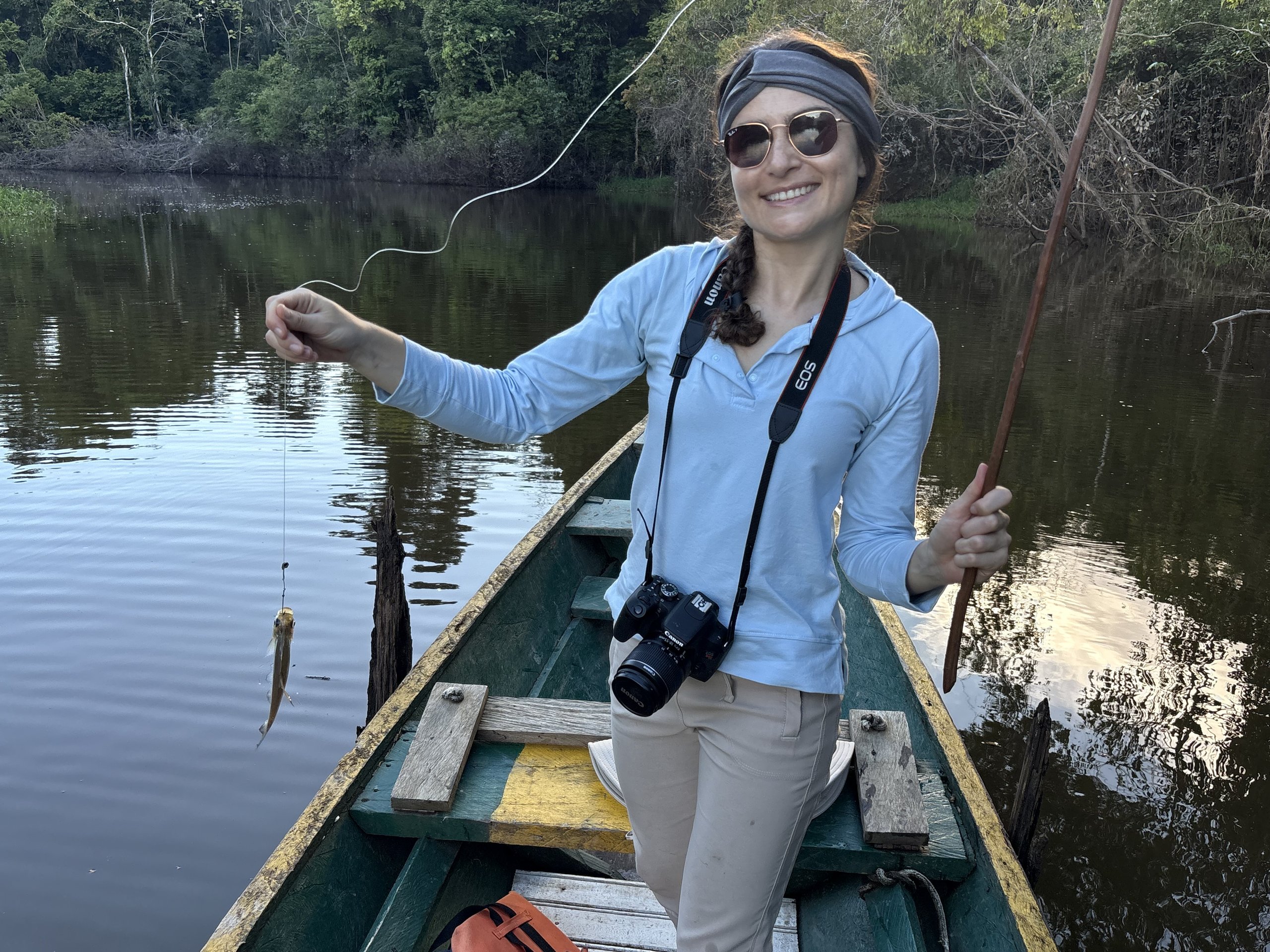
The cove. Bait lasts seconds.Diana and a lunarejo, golden hour.
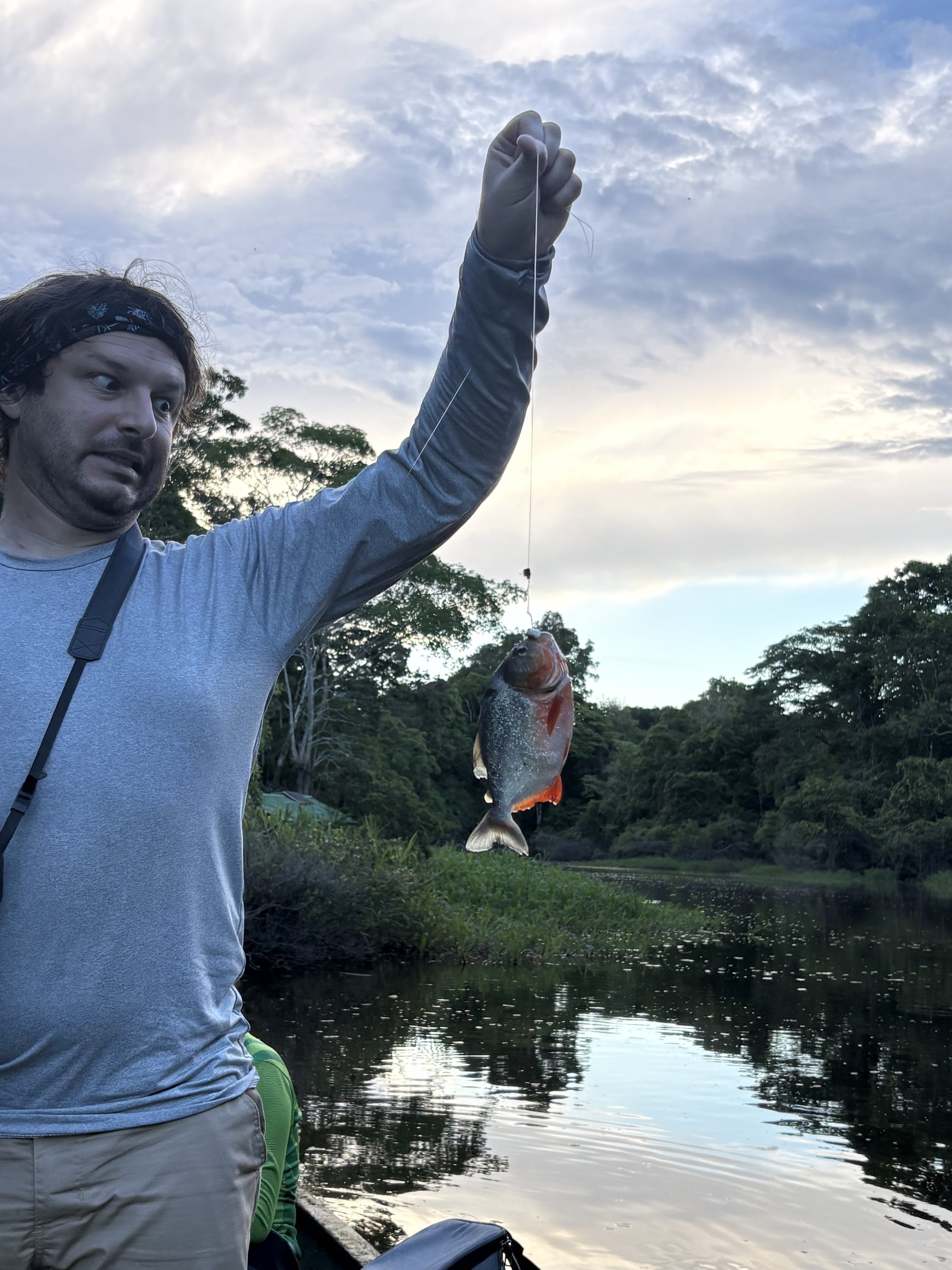
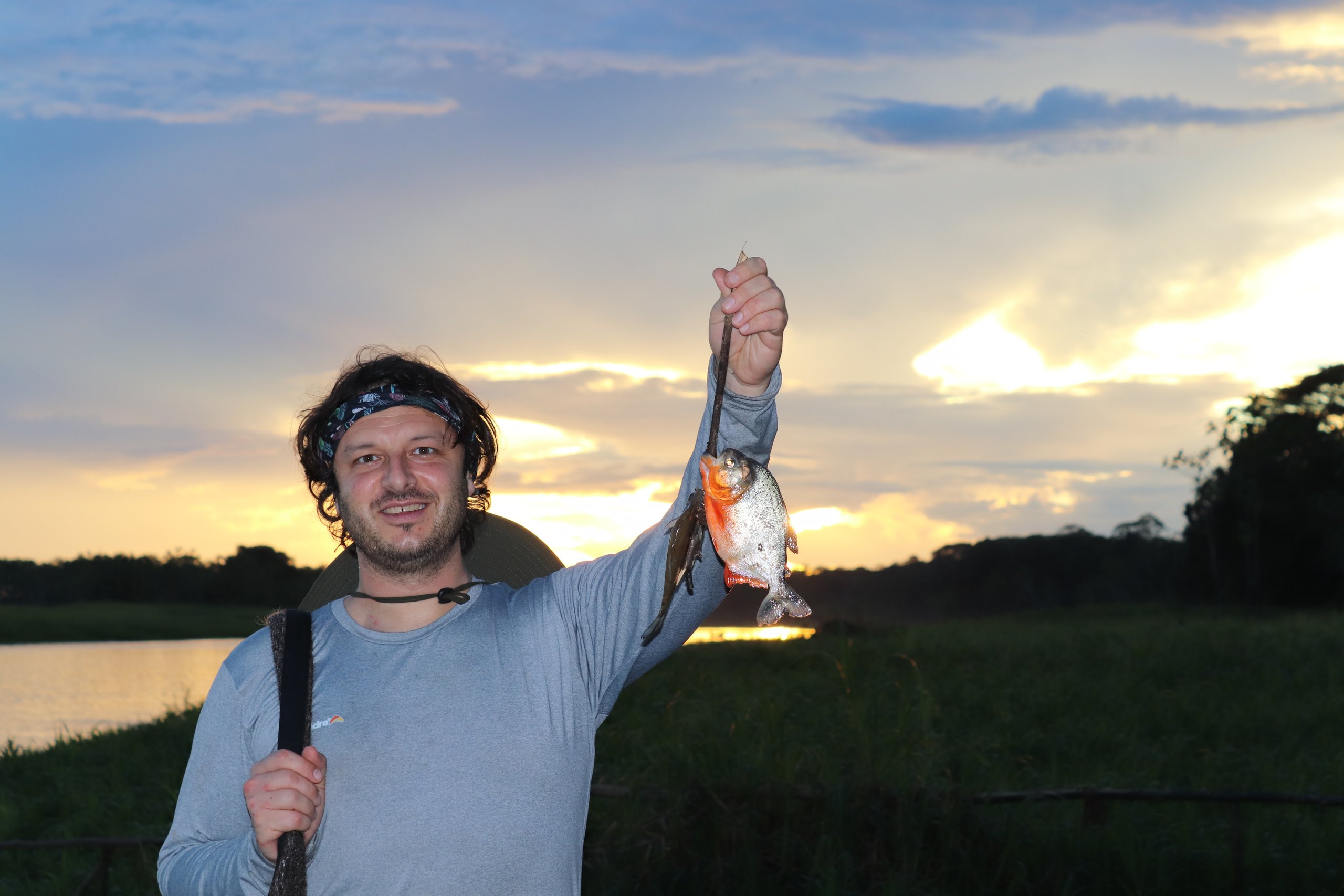
We caught three kinds. The lunarejo — the moon piranha, named the way you'd tease someone with a beauty mark. The vampire piranha, which looks exactly as advertised, all teeth. And then the piranha roja, the red one, the only catch that genuinely concerned our hosts. The reaction in the boat was as if we had boated a great white in the little cove. Colin, who had been flatteringly upgraded to a bigger pole mid-session, described the thing as all jaws and no tail — a creature that could maybe wiggle a little and then clamp onto something. They said it could take a chunk out of your leg. We believed them.
The piranha roja: all jaws, no tail.A great white sighting in the little cove.
That night the ladies fried our catch and fed it back to us. Fried piranha, caught by us, from the river we would decline to swim in. It was delicious.
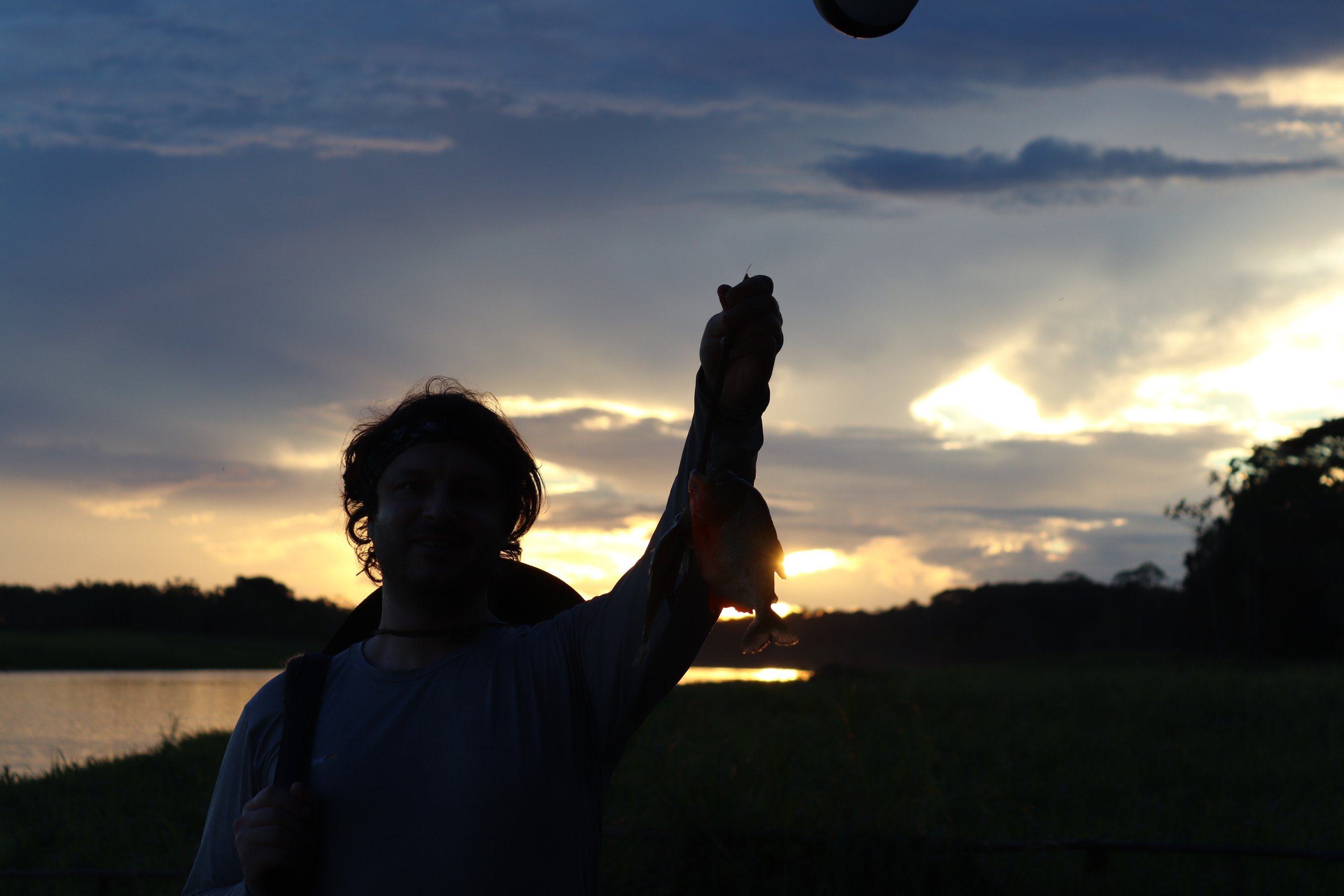
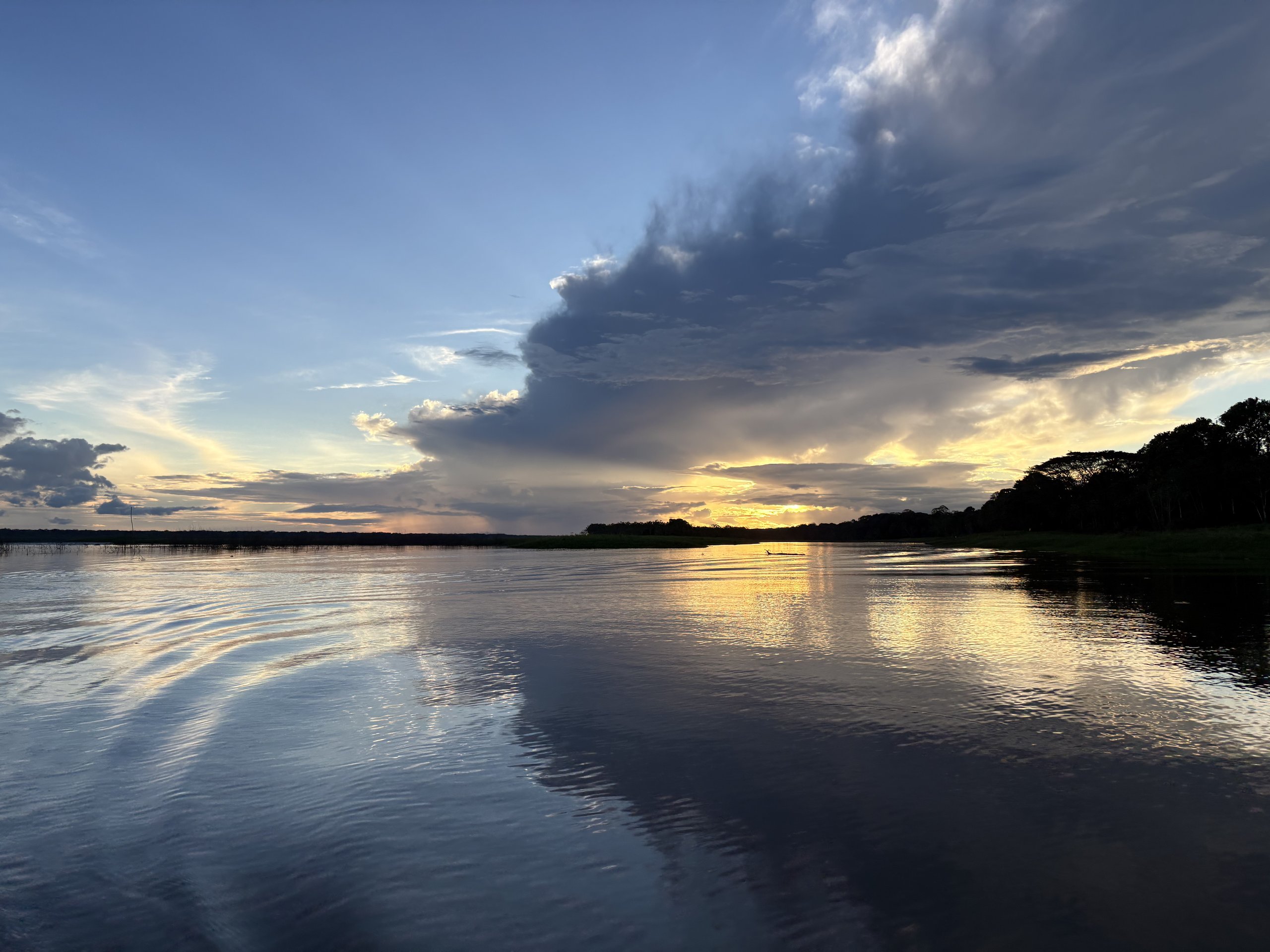
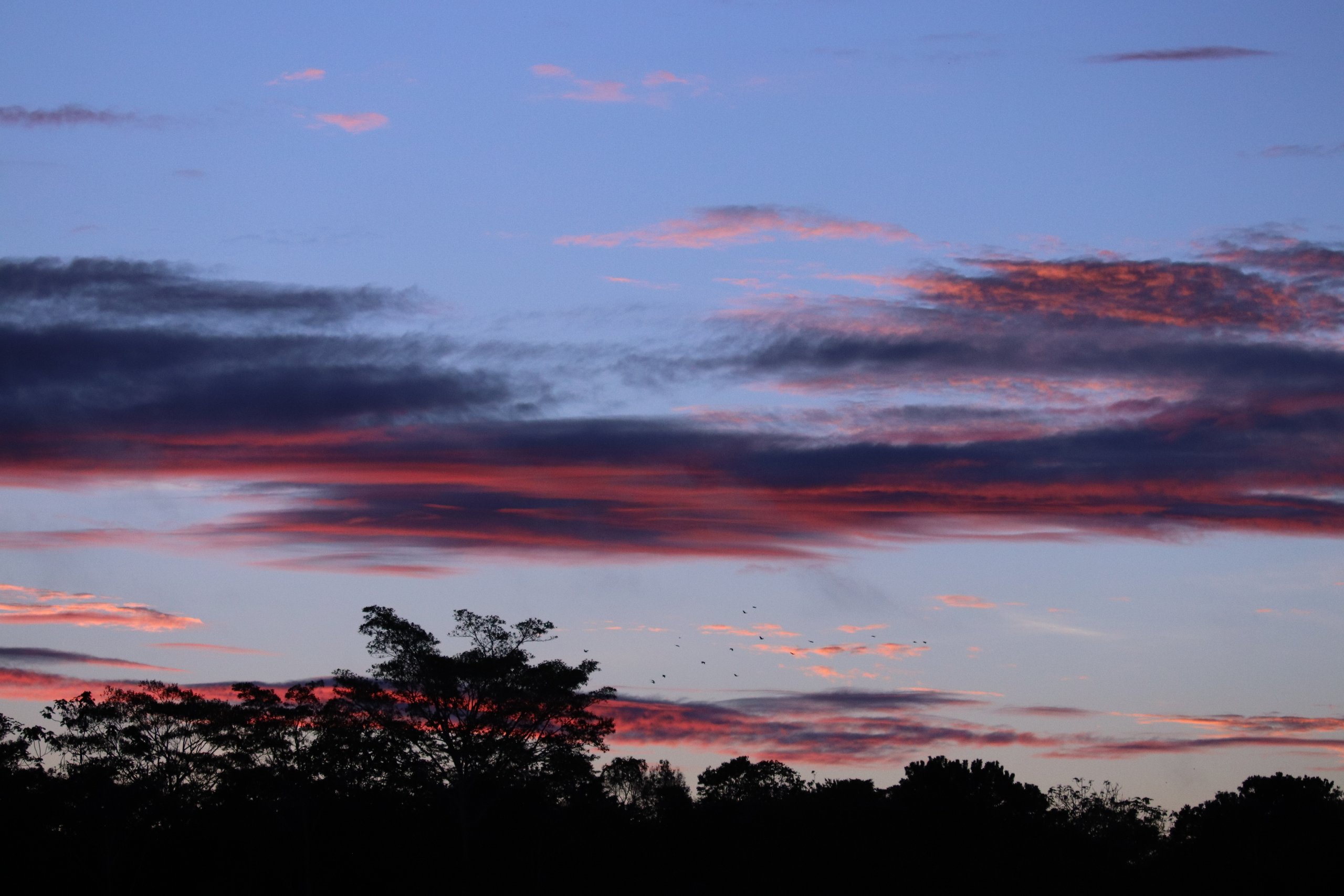
Silhouette with catch.The sky on the way home from fishing.
Macaws at Dawn
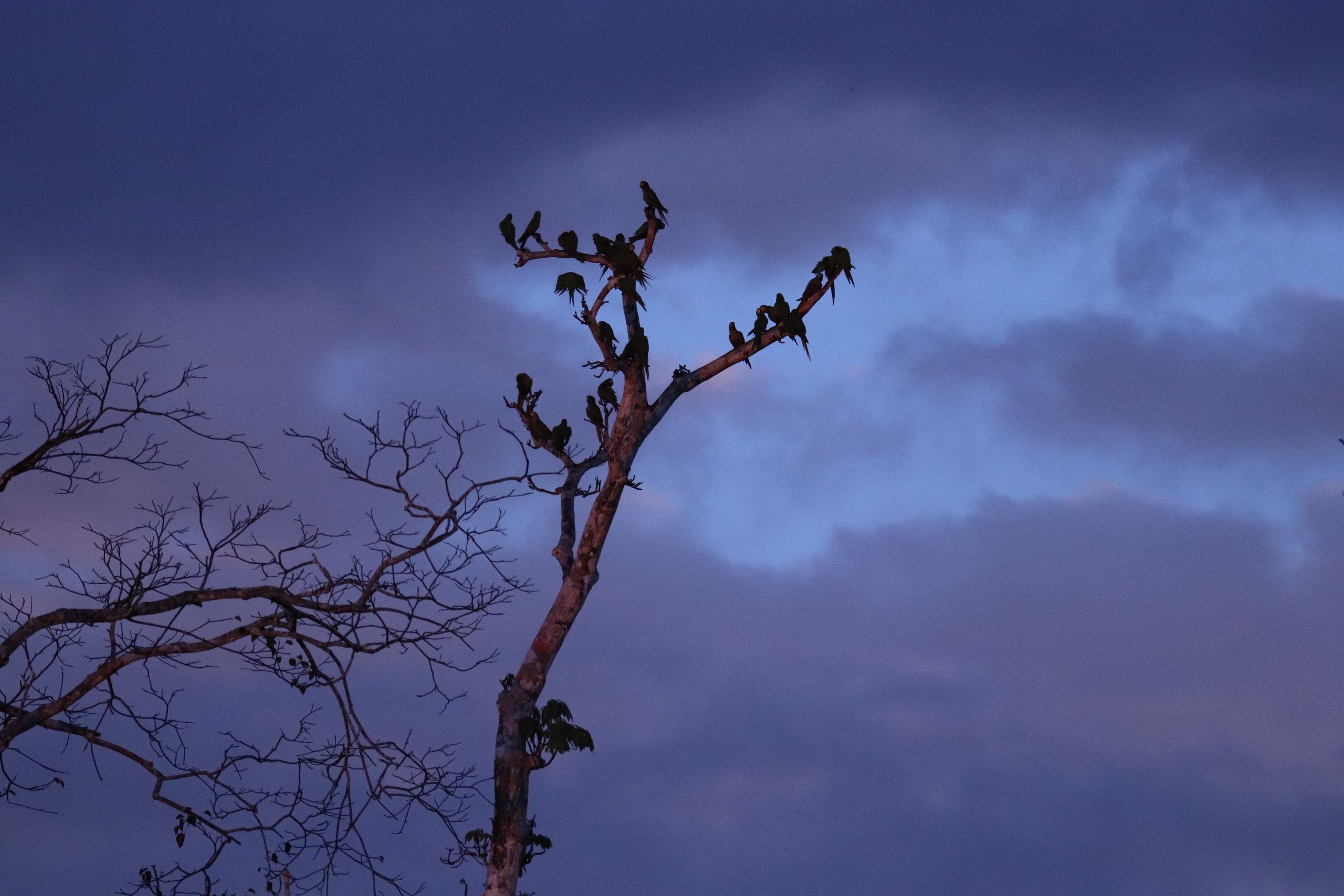
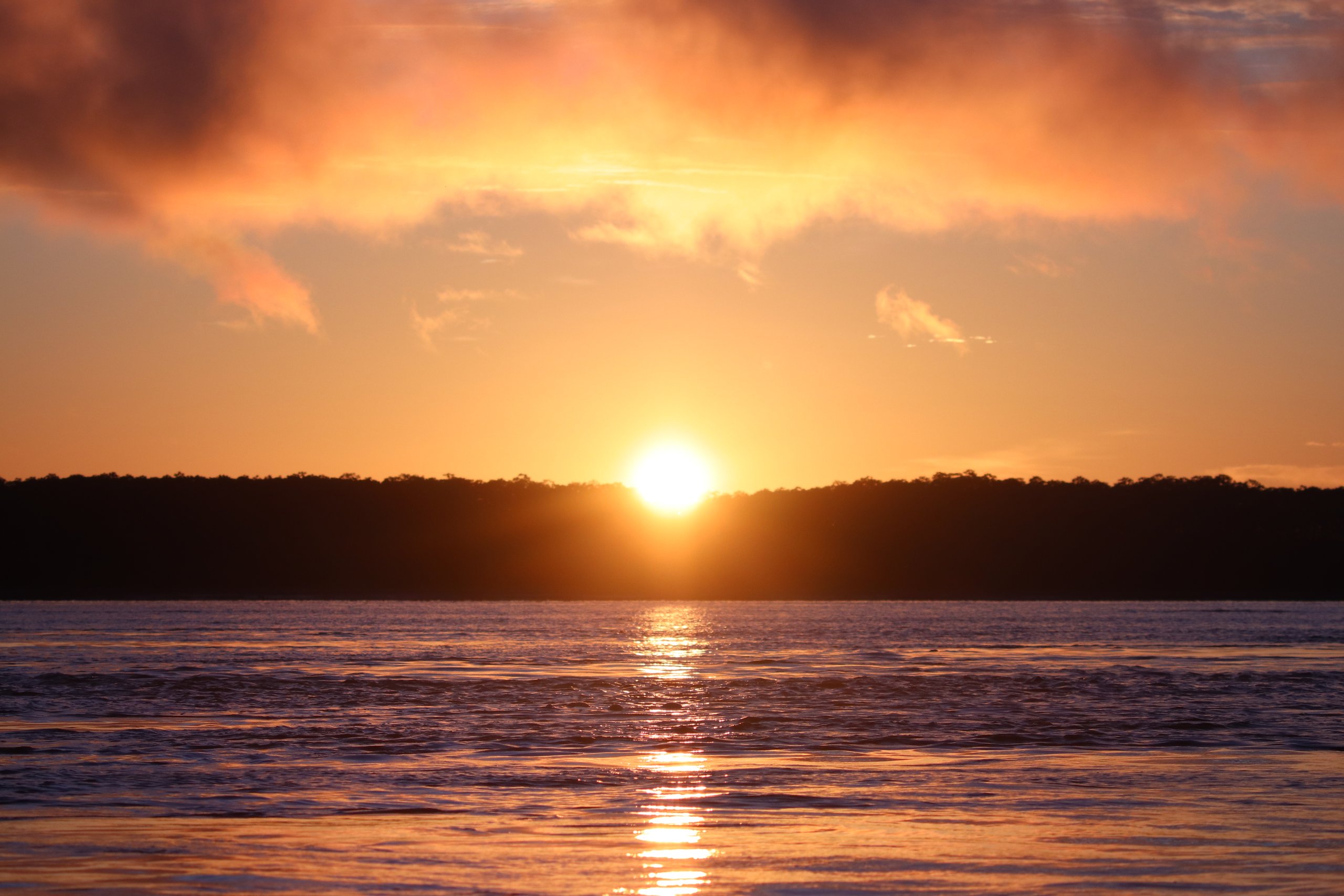
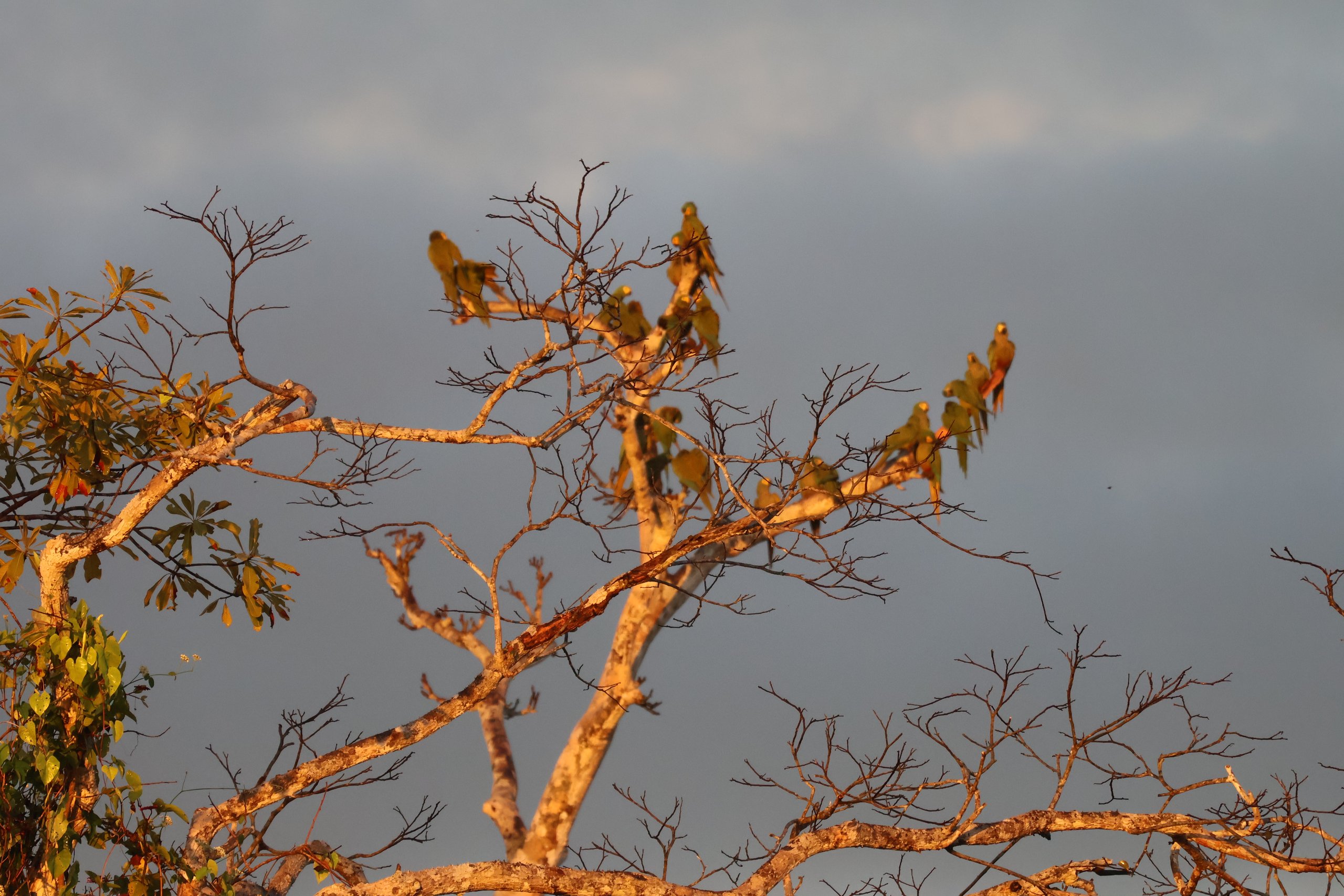
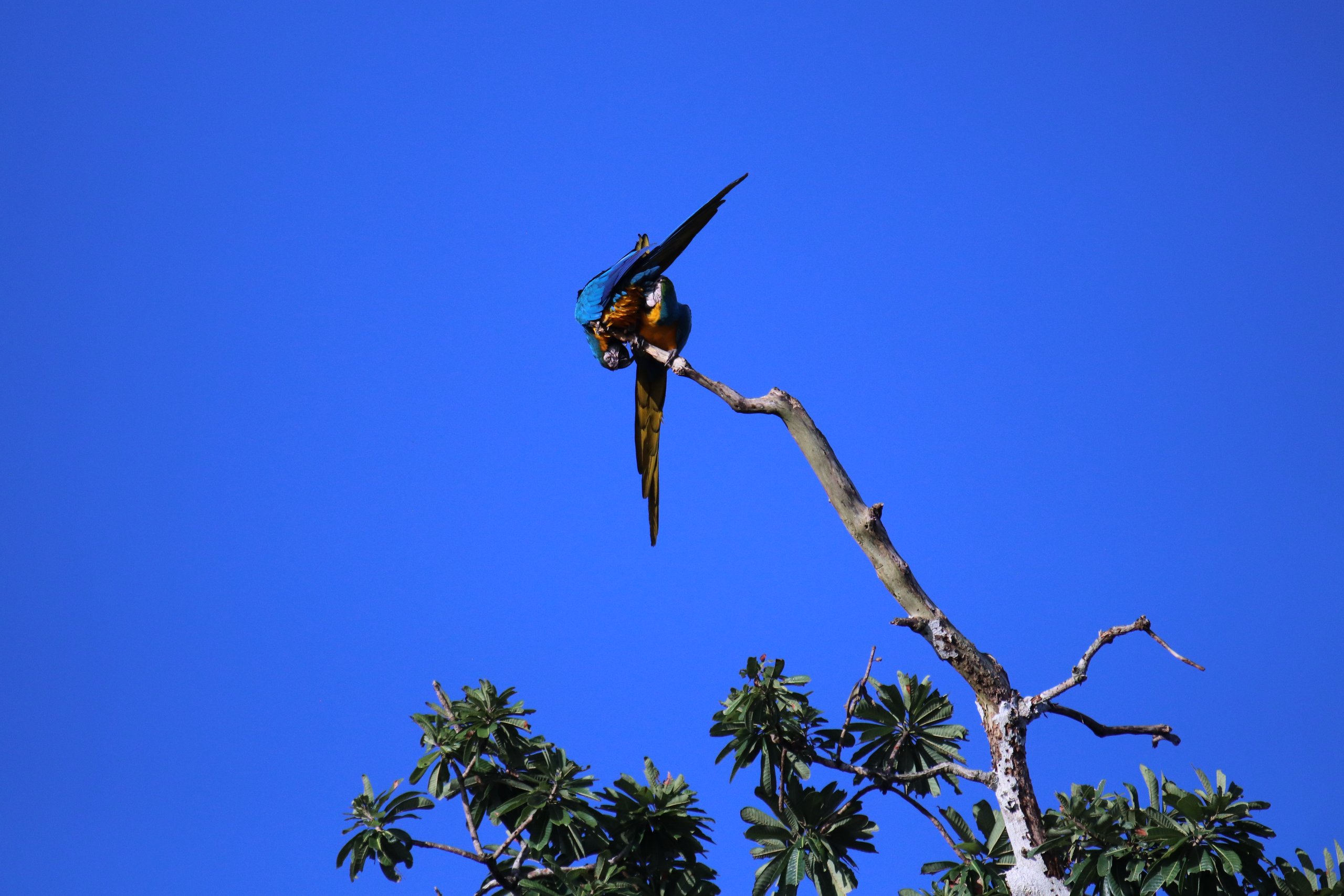
Five a.m., pouring rain, no idea whether the trip was on. Diana ran down the walkway to check. It was on. Our boatman drove us out under a pink sunrise, clouds of every color over the Amazon, to the Peruvian side, where macaws sit in the tops of dead trees and bask. The sun comes up over the bend of the river and hits those trees first; it's just a nice place to sit. There were maybe seven of them — rare, likely endangered — starting their day, fluffed up, disturbing each other, taking off and landing.
5:44 a.m. The pink sunrise, birds already moving.The roost: macaws in a dead tree before the sun reaches them.
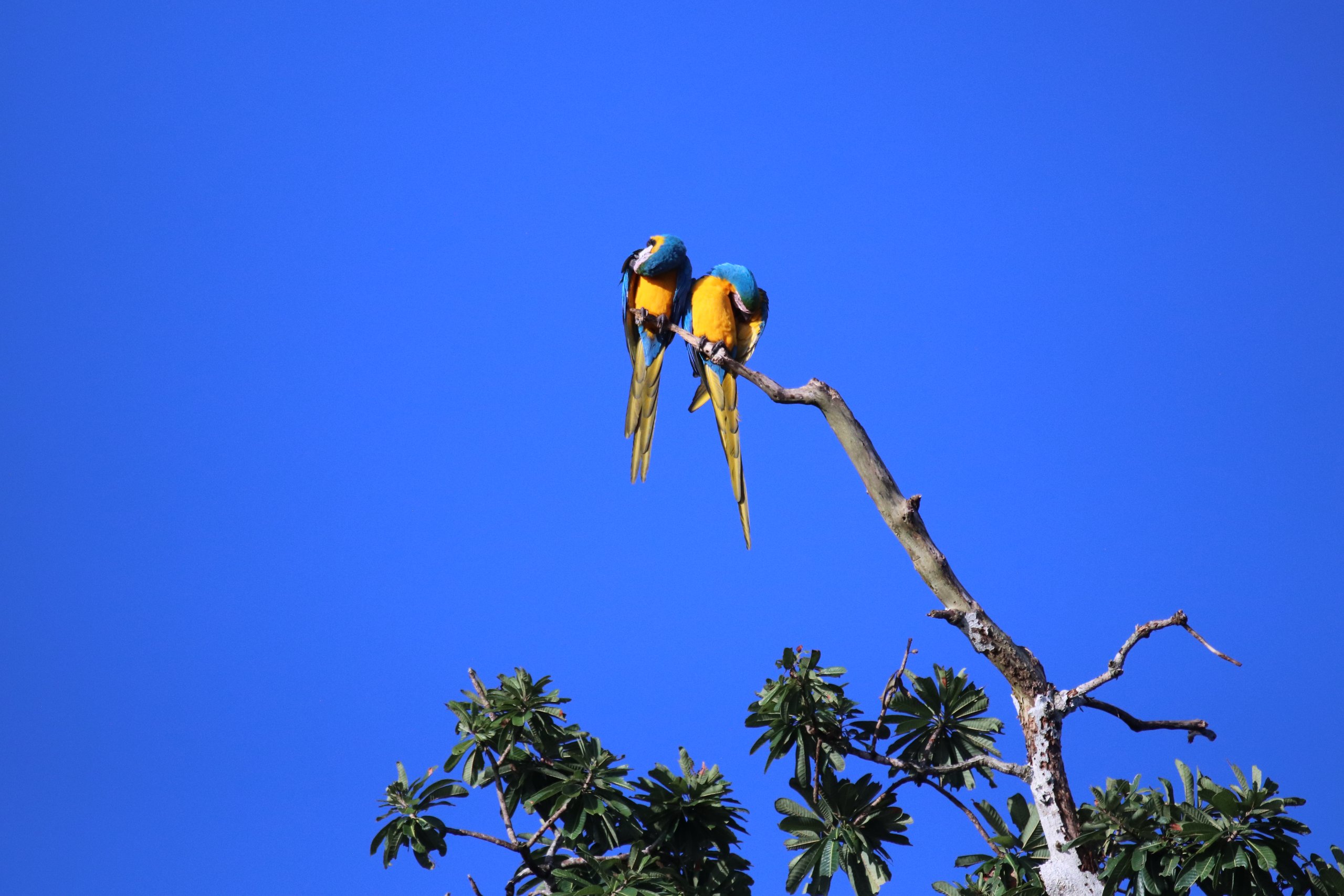
We were eaten alive. Two and a half hours in an open boat, donating blood the entire time, and worth every bite. The macaws have an unreasonable amount of personality: eyes that look made-up, like tattoos; monogamous couples bickering on branches; that heavy beak and those wing colors that ignite when the light comes through them.
Sunrise over the river, macaw side.Red-bellied macaw
And then the trip's best joke: walking back to our room, Diana thought to herself, wouldn't it be funny if a macaw were waiting outside our door — after we had just tortured ourselves for hours to see them. There was. A green macaw, right outside the bedroom, in terrible light, posing. Colin got the picture anyway.
A monogamous bonded couple, invaded on their morning.Takeoff.
Angel
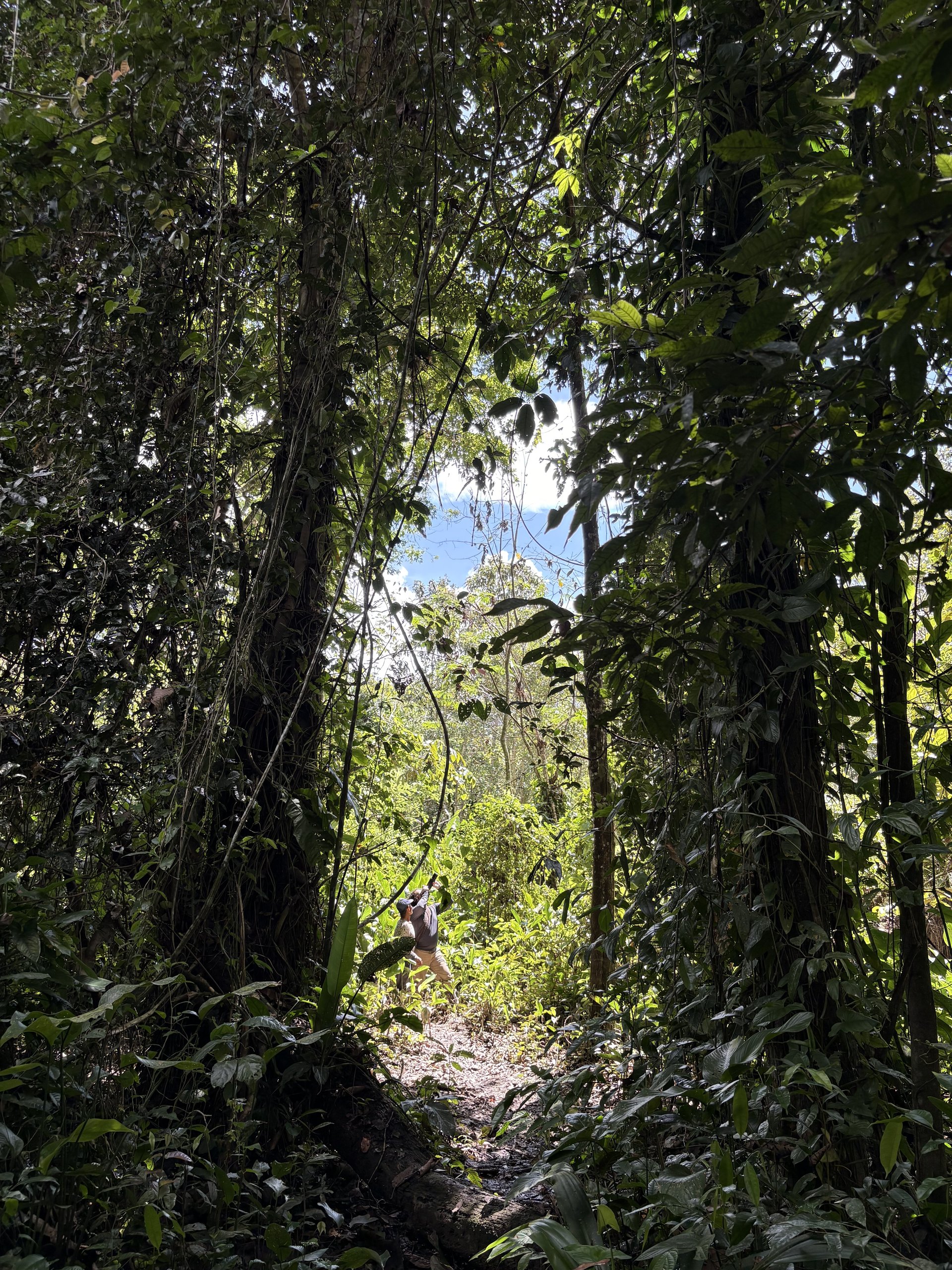
The guide who took us through the forest at Altamira, on the Peruvian side, was named Angel — an indigenous man in his late sixties or seventies who had worked that forest, his community's forest, for many years, and had recently retired. There was no one else to take us, so he came back for a day as a favor. He knew every leaf, every trail, every spot, in an area that is not small, and he was beaming.
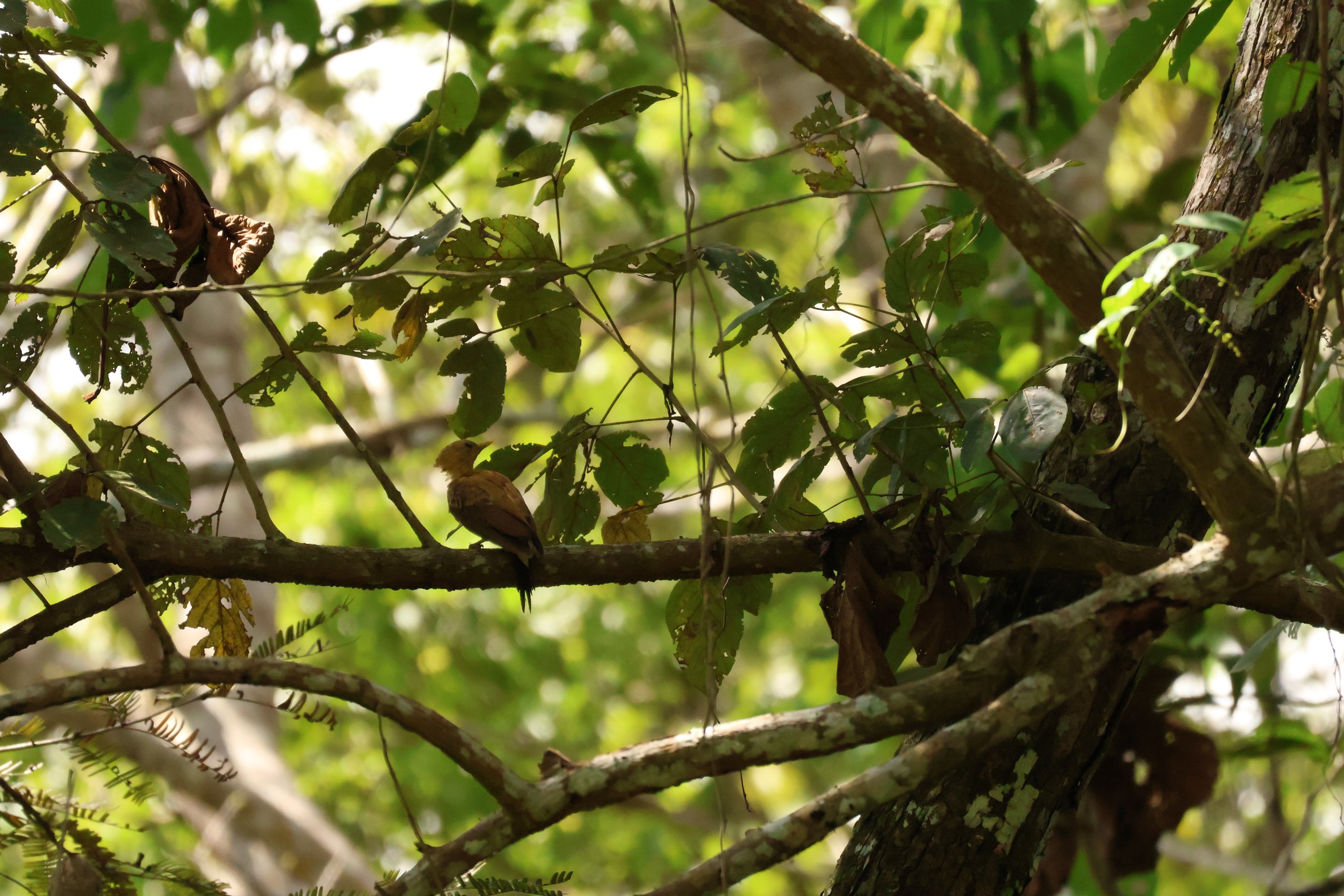
The woodpecker that turned Angel's day on.
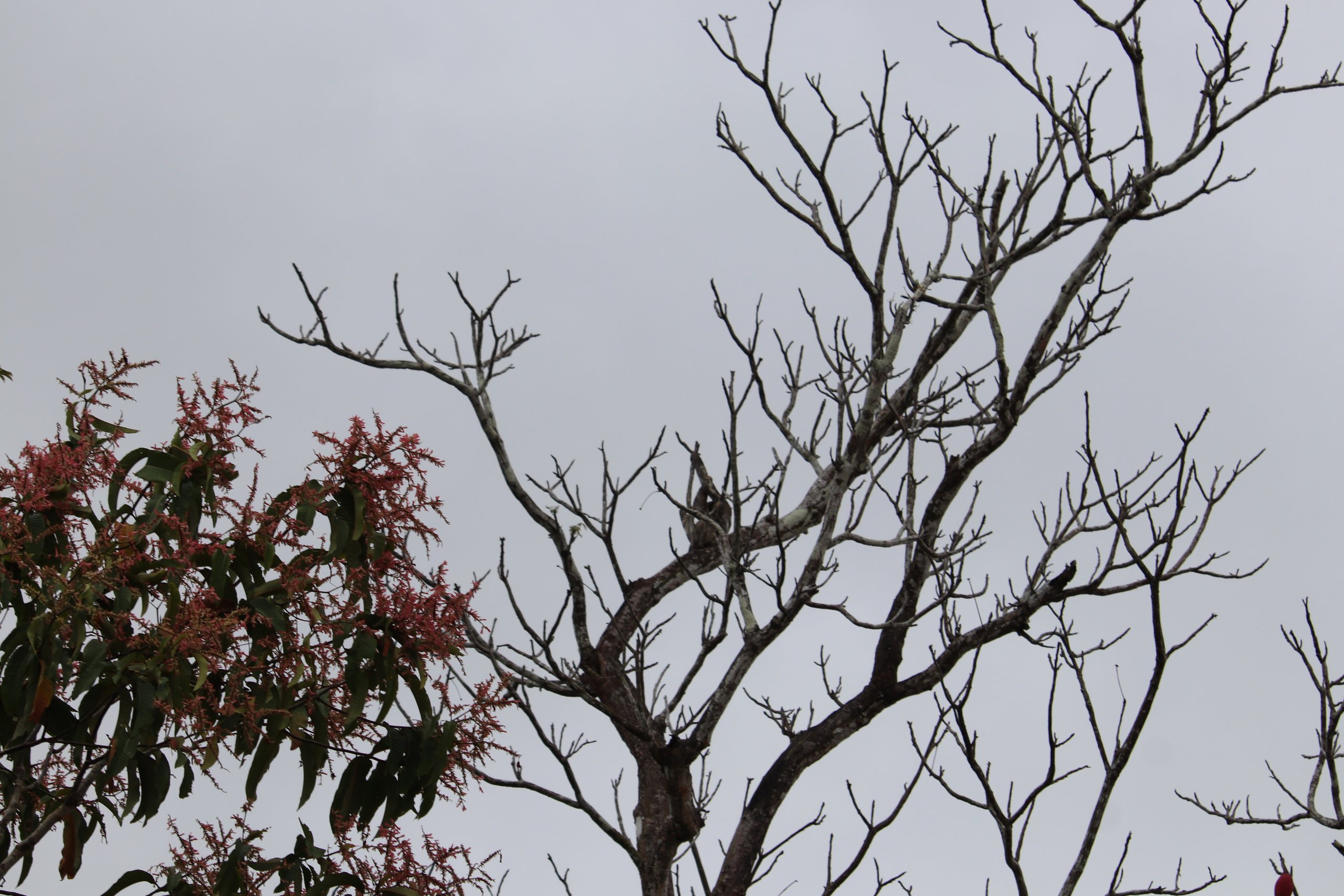
The moment it changed was a woodpecker. Colin got low, zoomed in, and took a good photograph of a yellow-headed female woodpecker, and when he showed Angel the back of the camera, Angel went completely engaged with the hunt. It was on. From then on he was constantly putting us in position — reading the light, the angles, the birds' habits — for shots we had no right to get. Rare birds against the sun with red bellies and yellow beaks and blue-and-white collars. A flycatcher snatching a wasp out of the air, multiple action shots of adorable little critters. Leafcutter ants on their highways, filmed hauling absurd cargo up vertical trunks.
Angel's forest goes farther in every direction.
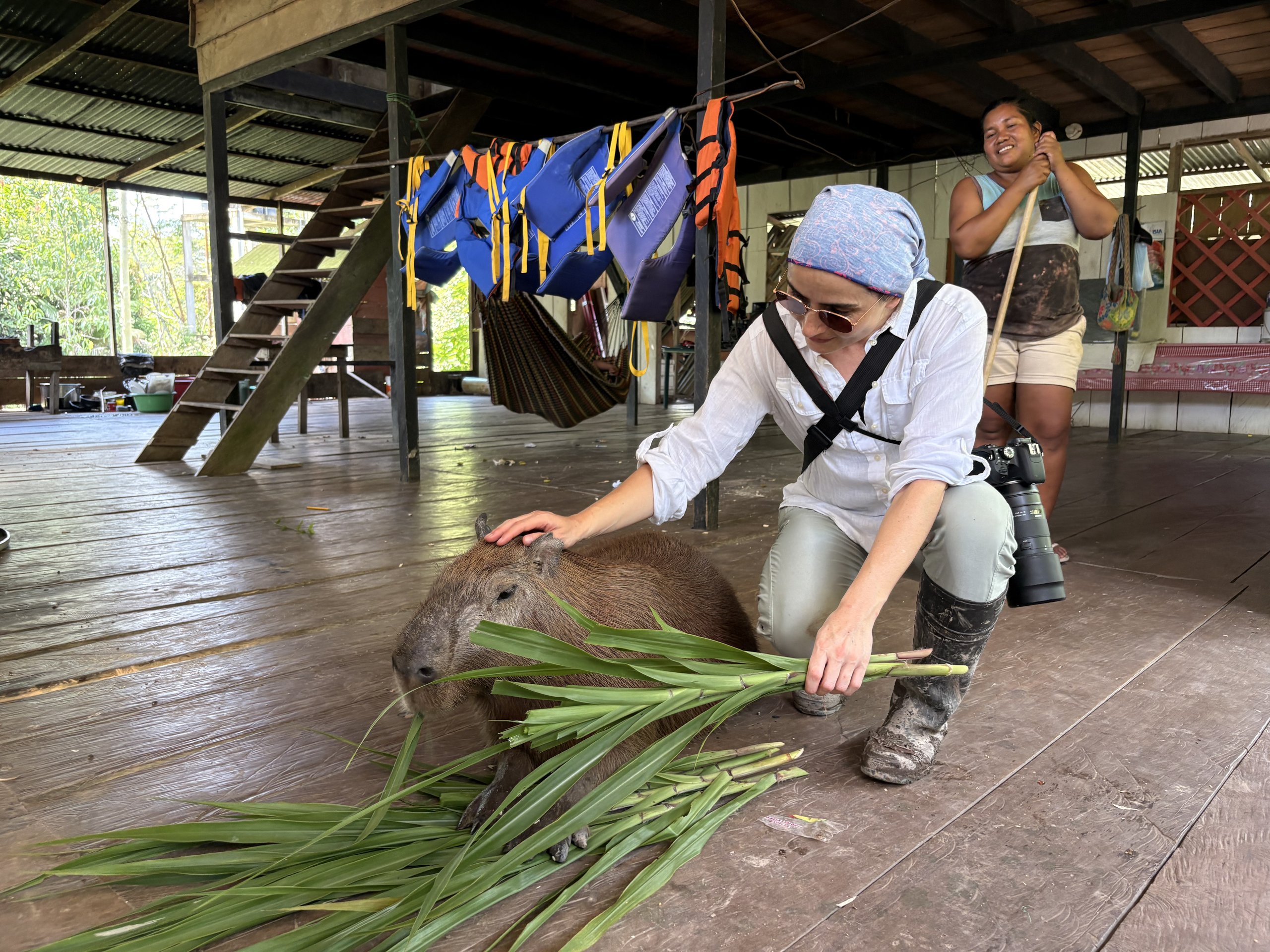
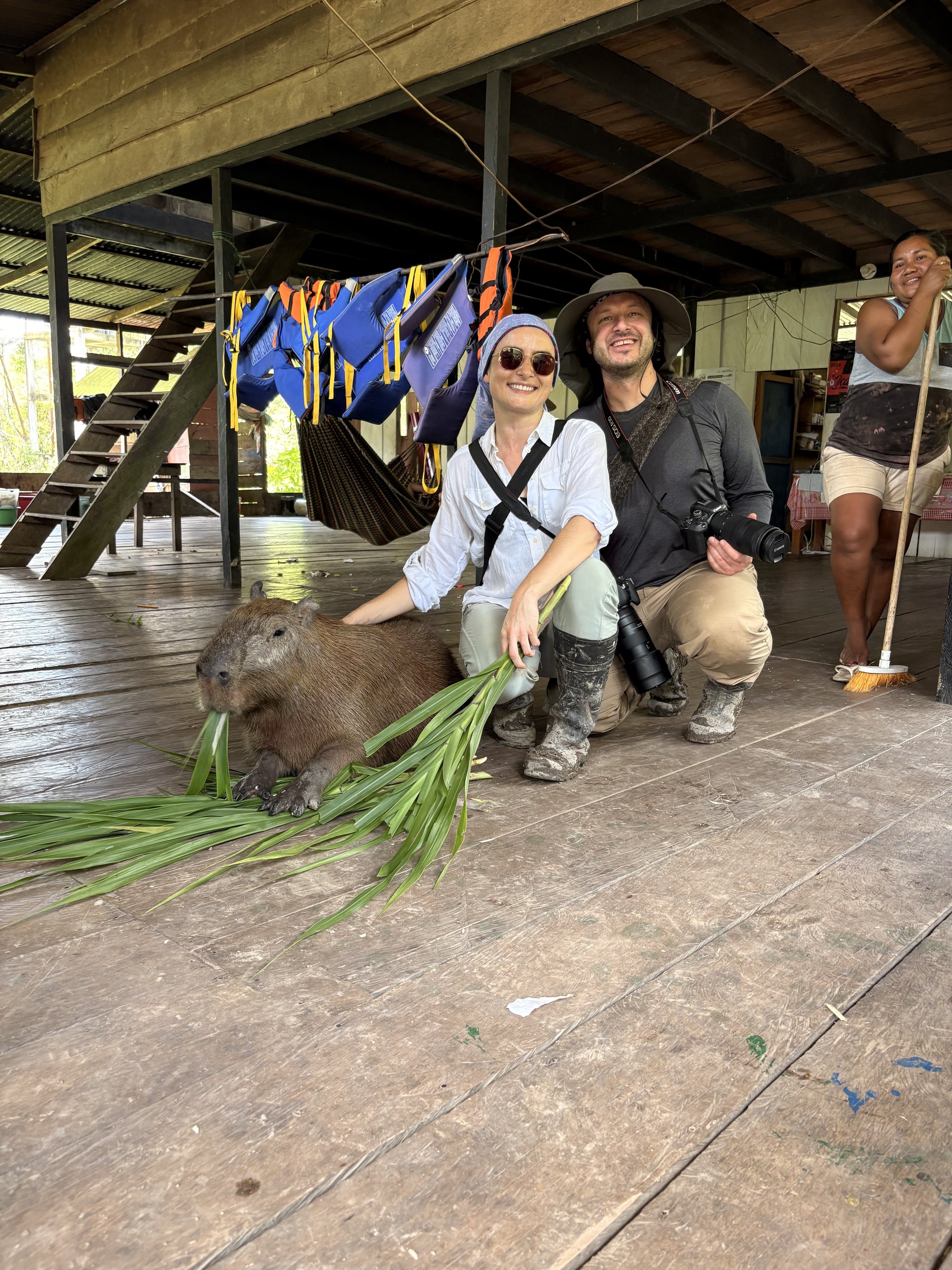
At lunch near Vista Alegre, Angel asked if we wanted to stop at a house where a capybara lived. We hesitated — we didn't want to support keeping a capybara in captivity. It turns out the capybara is keeping the human in captivity. She roams free, disappears for days, and comes back to be adored and fed. She was very pregnant and completely at ease, a wild animal who had adopted a household. Everybody adores her.
The capybara who keeps a human.
When it came time to tip Angel, Diana had only Colombian pesos, and we were standing in Peru. It didn't matter. In that community they only operate in pesos; the nearest Peruvian city is too many miles away to matter. Technically Peru — and Colombian in all kinds of ways. Amazonas doesn't much care where the map draws its lines.
Everybody adores her.
The Thing in the Water
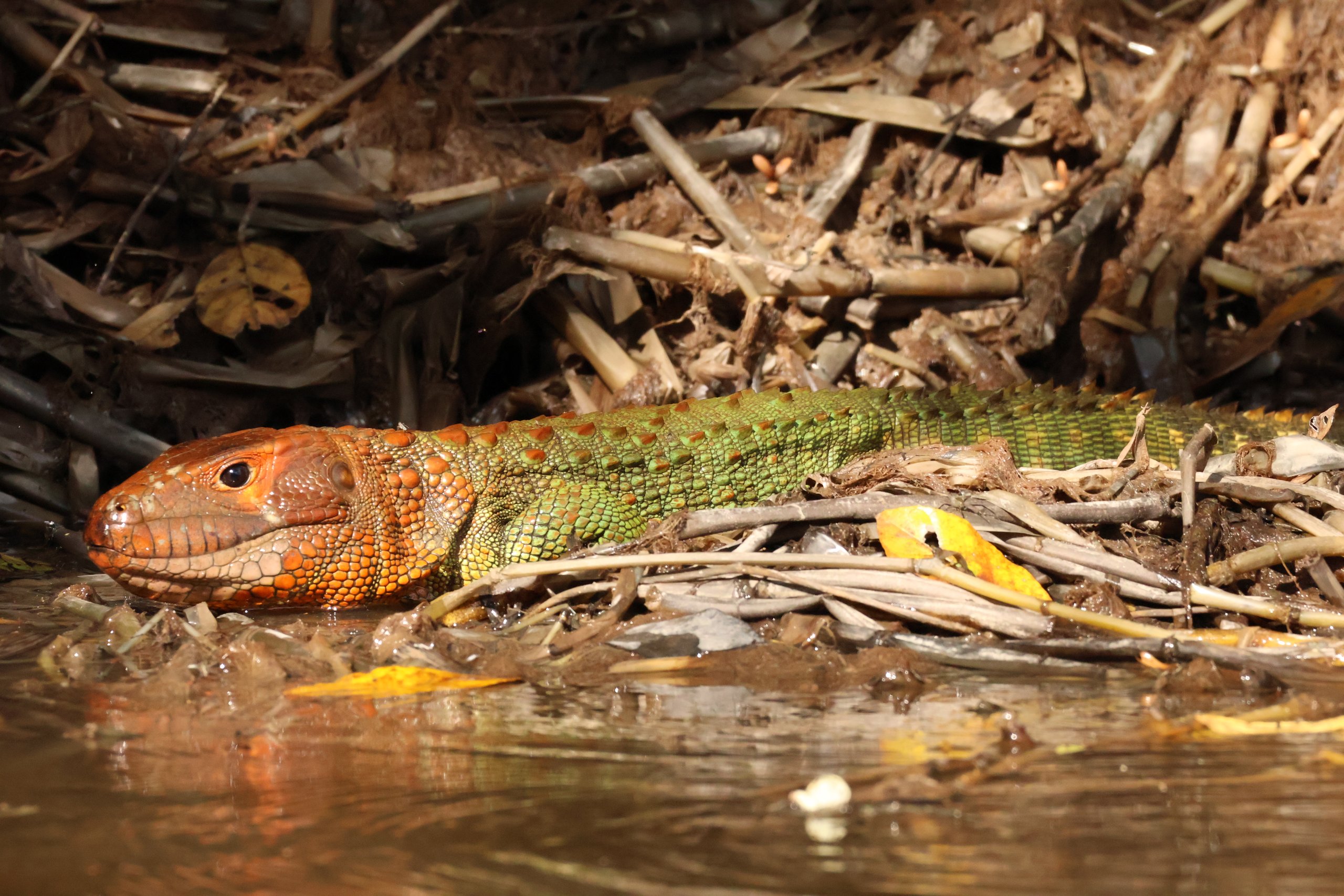
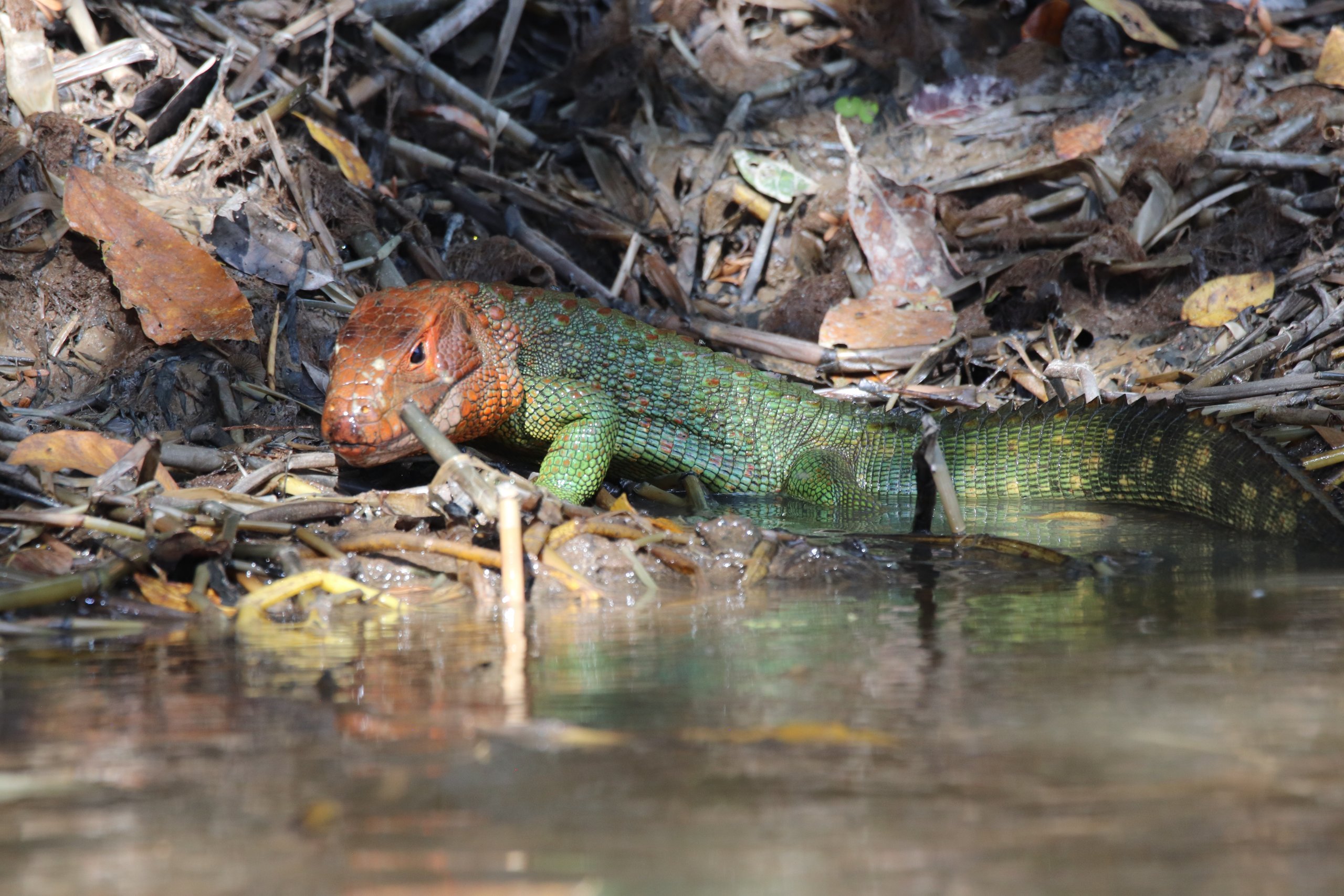
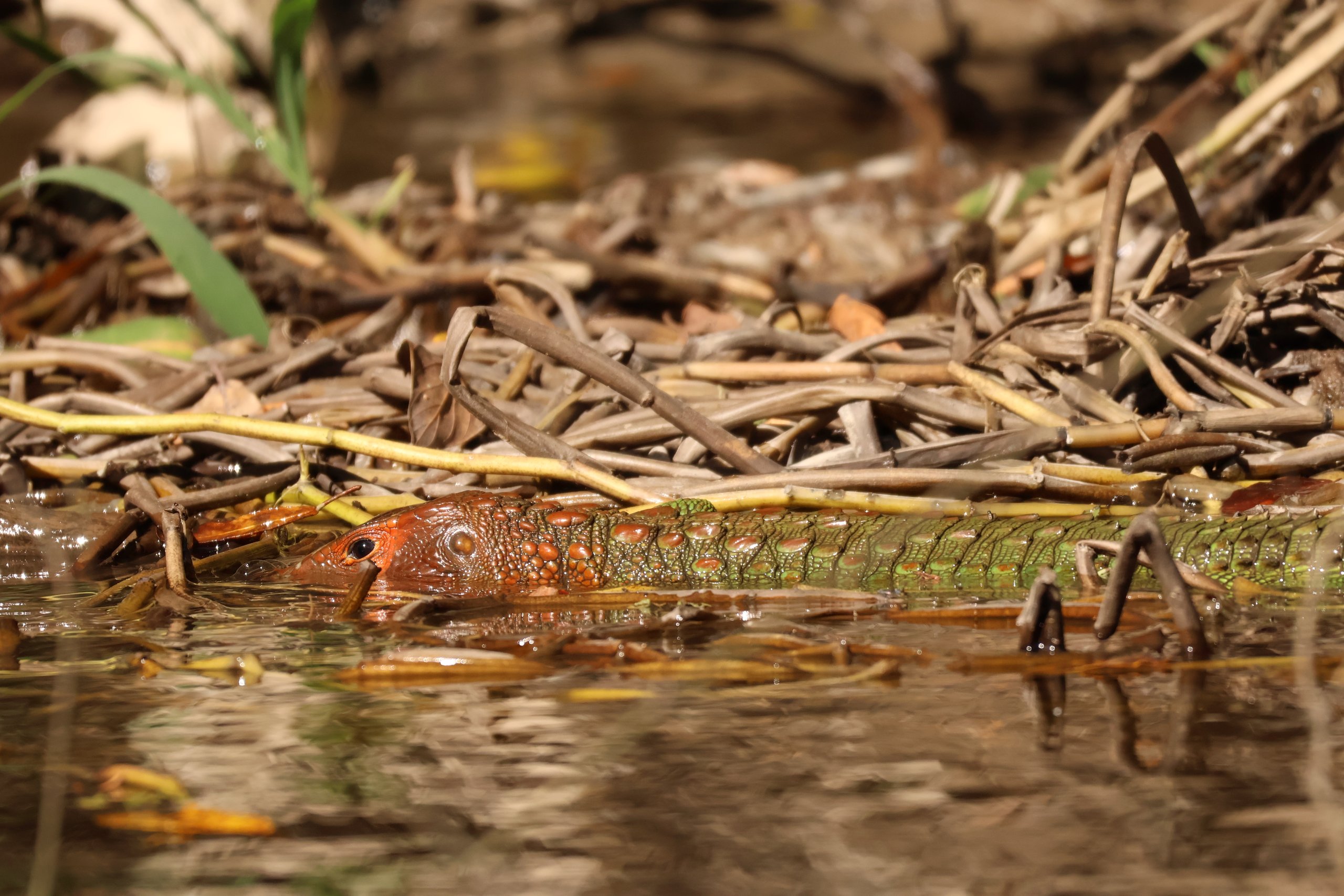
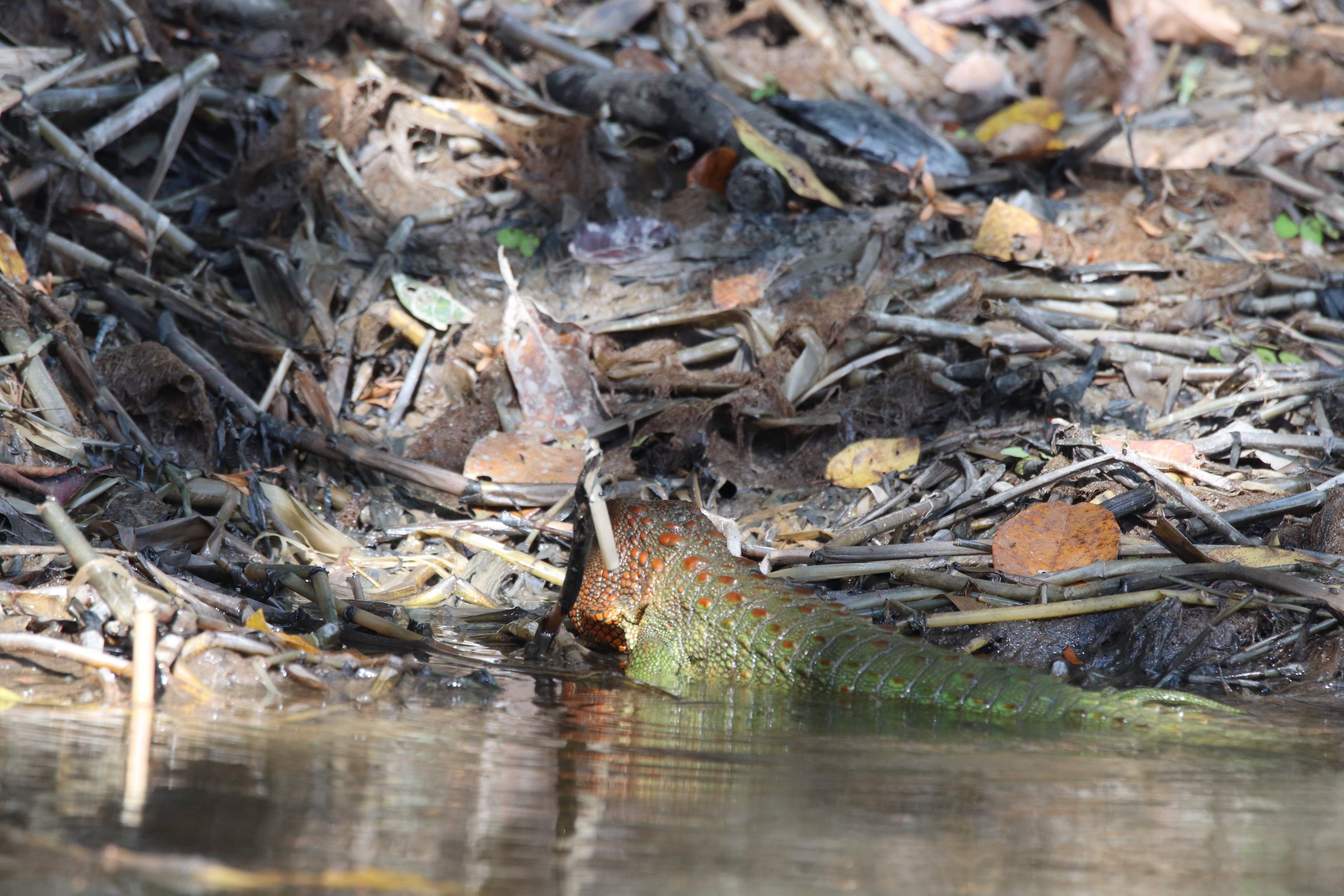
On the way upriver to Lake Tarapoto, in what was certainly one of the climactic moments of the trip, there was something in the water ahead of the boat. The head said snake — it swam near the surface, leaving a long trail. But it wasn't a snake. It was an aquatic lizard of a kind we had seen only in nature documentaries: a bright red head, a blue-grey body, a ridged back that emulates an alligator, a forked tongue it kept throwing, huge stubby hands with two long fingers. Diana remembered the Animalario, the Humboldt Institute book she'd given to Dante where you mix and match thirds of animals to invent impossible ones. It looked like someone had manifested a page of that book: a snake, an alligator, and an iguana bolted together.
Something in the water in front of us.
Gloria — our guide, who works in conservation and reforestation and is on these rivers constantly — was stunned. She hadn't seen one in eighteen months. For a long while the animal was nothing but an eye near the waterline, hiding behind branches, an entire boat of humans holding its breath over an eye. Then it blinked. "It blinked." That went around the boat like news. It crawled out and ate plants and wandered and hid again, and between the two of us we took something like five hundred photographs. Gloria and Will kept almost calling it — okay, that's enough — and kept not calling it, and at the end they were grateful we stayed. She said afterward it had been a really special trip for her.
You can't believe it's not a snake, because of the tongue.Northern caiman lizard — Dracaena guianensis, named at last.
At the time, nobody in the boat could name it. We can now: it was a northern caiman lizard, Dracaena guianensis — rare, semi-aquatic, and exactly as improbable as it looked.
Out of the water at the edge of the black lake system.
The Black Lake
We almost didn't get in. At the entrance to the lake system the gatekeepers didn't want to let anybody through, and it had nothing to do with money — they'll throw the ledger at you if you insist. The rule, imposed by the indigenous community there, is about the size of your motor, and ours was too big. We should have switched into a smaller boat. Will asked nicely. They let us through.
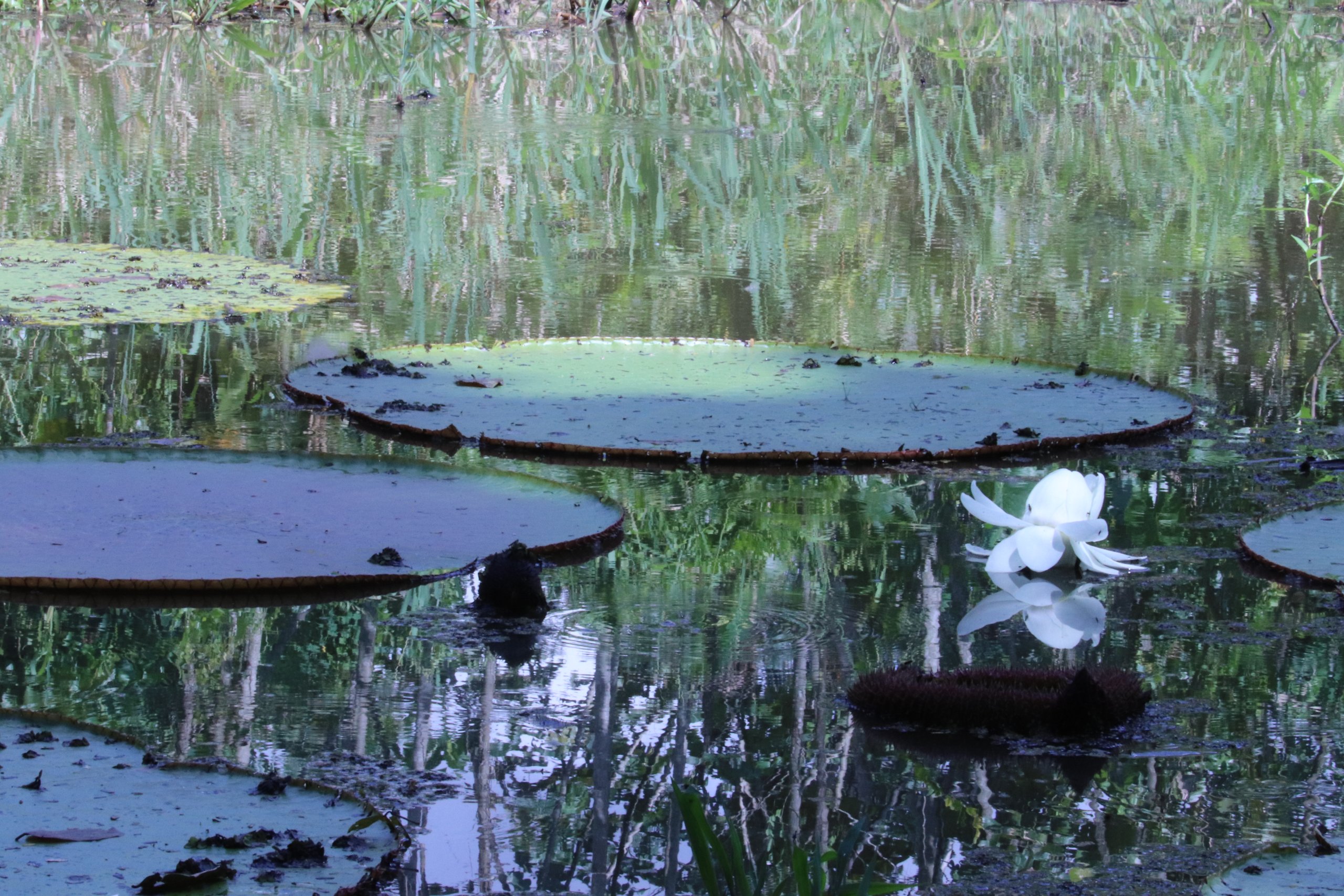
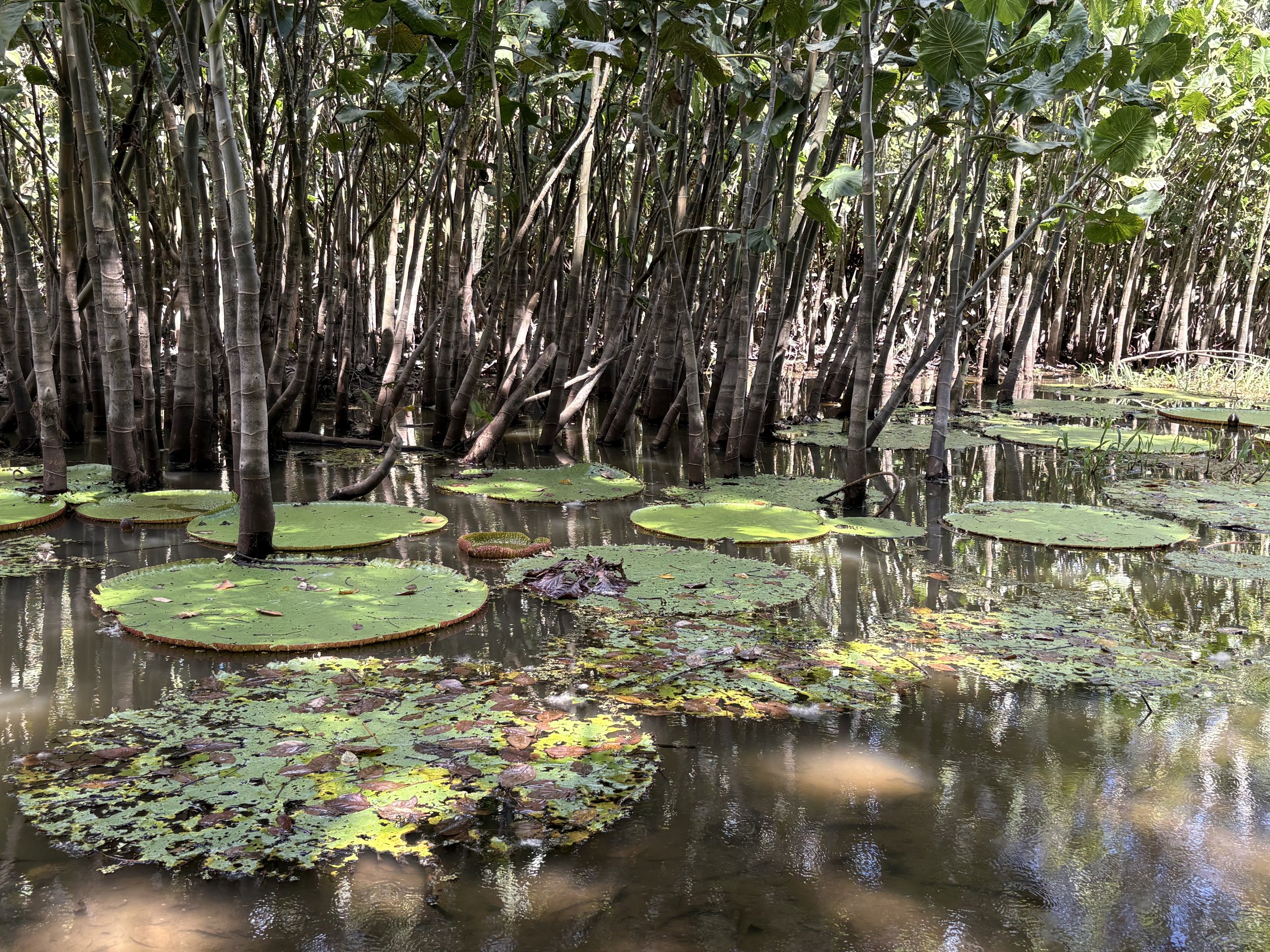
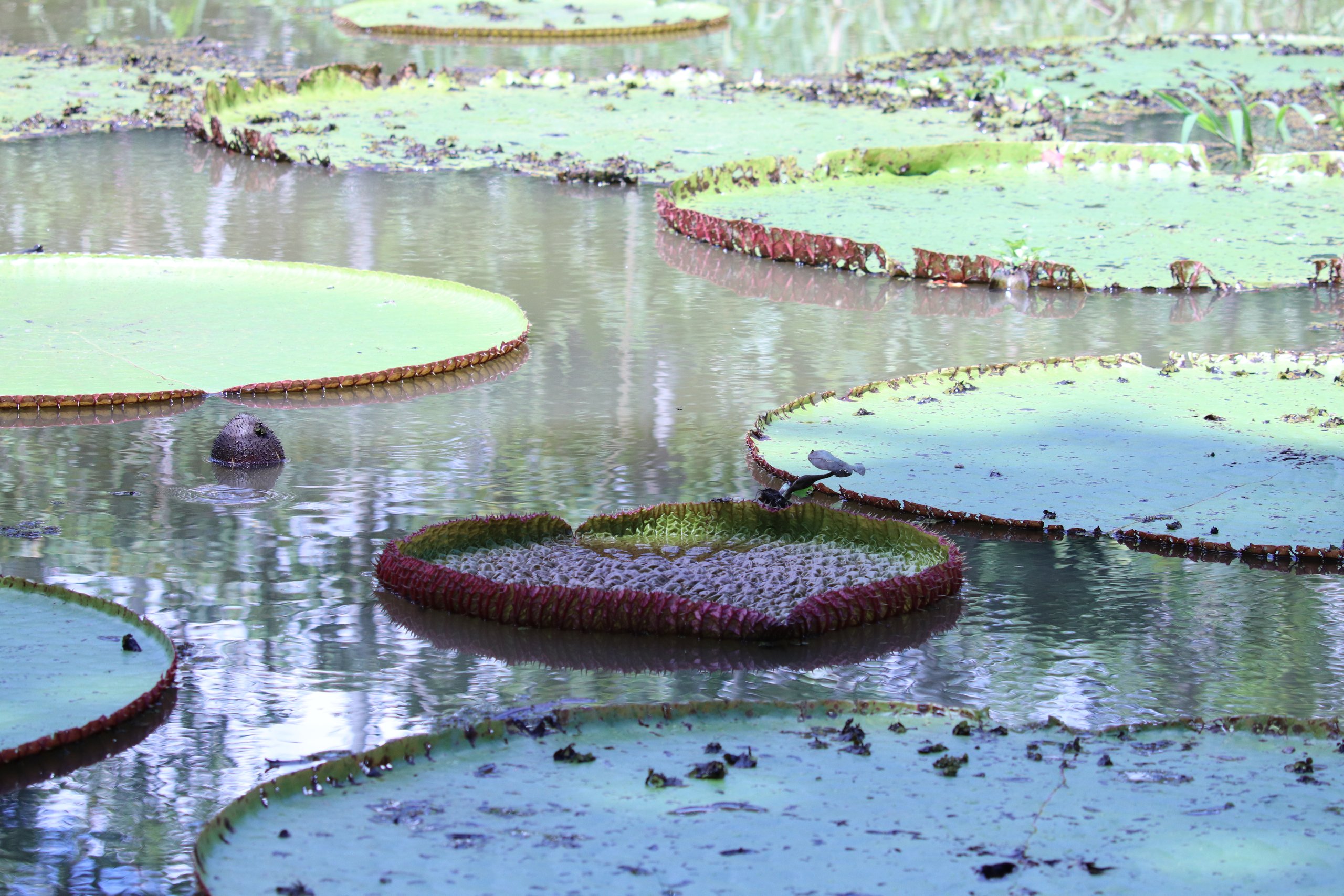
Victoria amazonica in the flooded forest.Black as ink, perfectly clear.
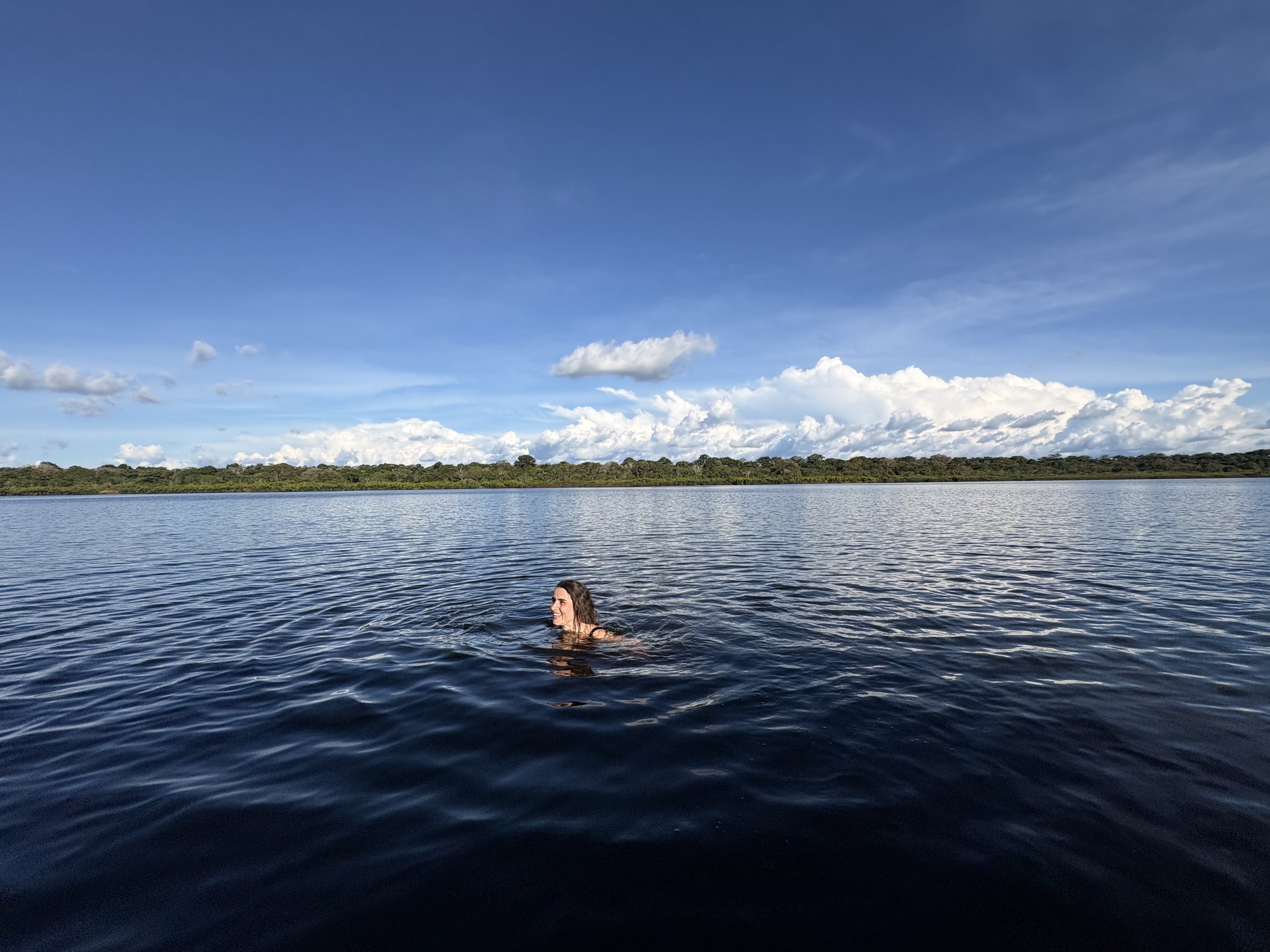
Lake Tarapoto is one of more than twenty lakes, all connected, and as you go deeper the water changes. The Amazon is mud you cannot see into; the lakes are something else entirely. The water is black — black as ink — and at the same time perfectly clear. It's the tannins from the trees, the same chemistry as tea. Mangrove-looking forest on one side, dense jungle on the other, leaves dead below the old waterline. Not a person in sight. It was one of the most beautiful places either of us has ever been on Earth. Bar none. You could go a hundred times and see a different drama every time; there are twenty lakes, and you could get very lost up there.
A turtle borrows a lily pad.
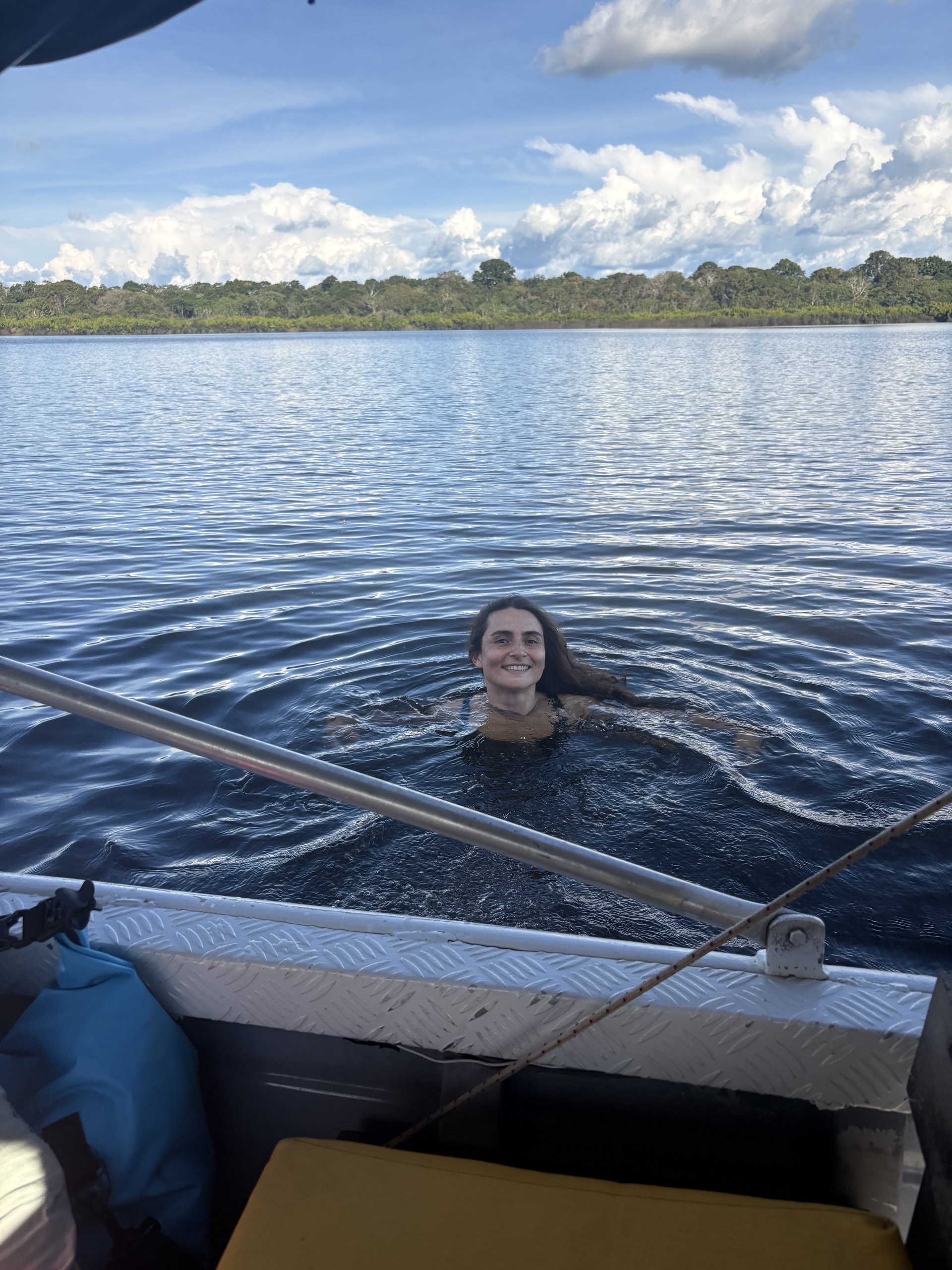
And we swam in it. Here the safety briefing deserves to be quoted precisely: it's safe during the day — the anacondas are not a problem, the caiman stay in the bushes, and the piranhas are not a problem if you're not breathing. Everything out here is circumstantial like that. Swim at the wrong hour and you'd die; swim at this one and you're floating in black glass in the middle of the Amazon. Being in that lake is the whole trip in microcosm: the deadly things are real, and they are not in this place at this time, and the space between those two facts is where all the magic happens.
Swimming in Lake Tarapoto. The piranhas are not a problem if you're not breathing.
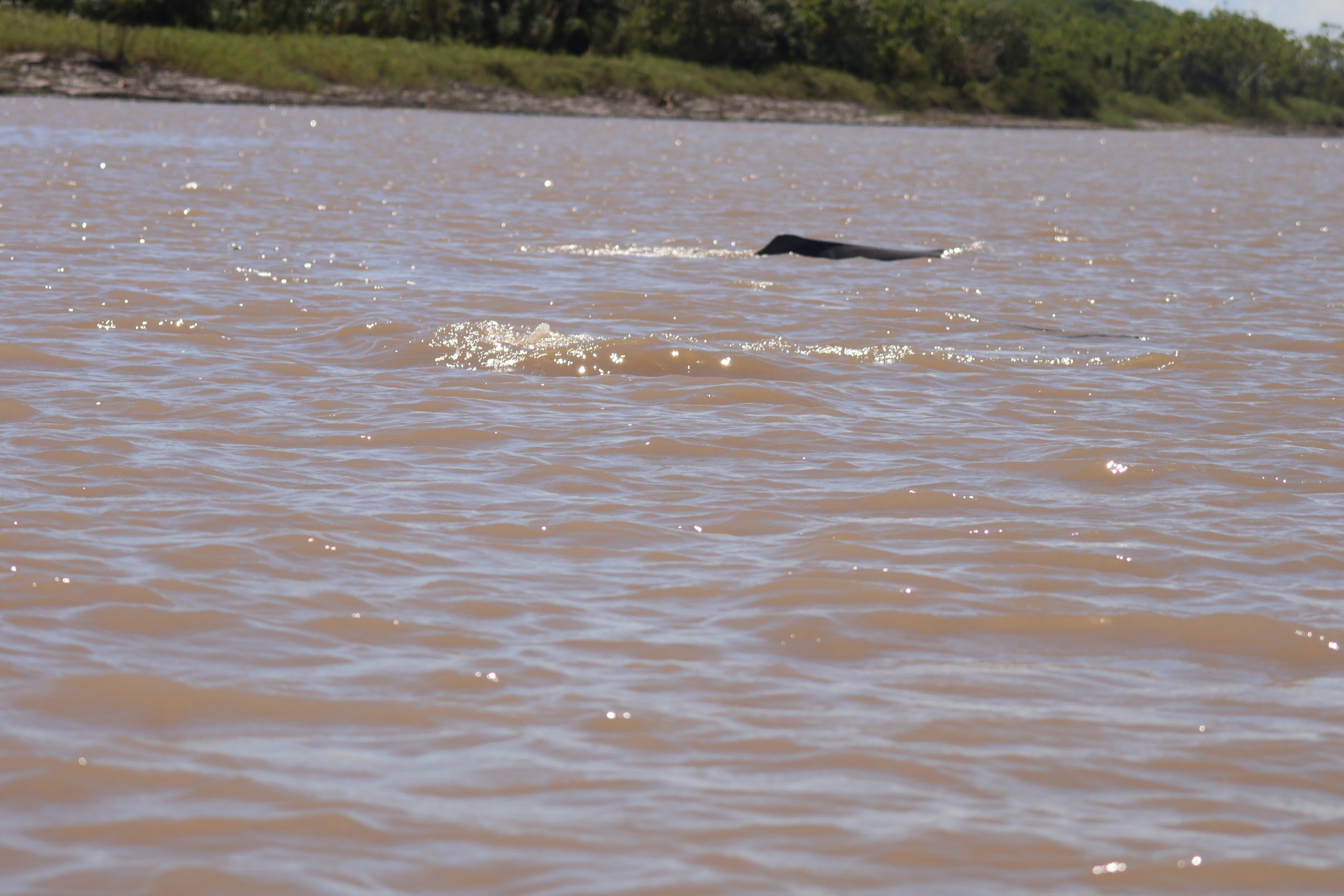
Coming back past the entrance to Amacayacu — the national park where Diana's parents were married — a family of gray dolphins met the boat and rode with us for a quarter of an hour. Minutes before, Gloria had said we were unlikely to see dolphins with the river so low; seconds later, a pink one surfaced. We got the photo of the park sign for Diana's mother. We were greeted at the door of her parents' story by dolphins.
Black glass, middle of the Amazon.The pink dolphin Gloria said we wouldn't see.
The Epicenter of Not Controlling
Some of the other guests were having a different trip. A family at the next table — every breakfast, lunch, and dinner — wore mosquito nets over their heads to dinner and complained: about the animals being ugly, about the dolphins being insufficiently pink, about everything. They reported a young man to their travel agency for keeping an anaconda in captivity; he had been rehabilitating it to rewild it, and because of the complaint the community lost the ability to bring visitors to see it, and people were afraid jobs would follow. That happened in real time while we were there, enlightenment imposed from a great height, with no understanding of what it landed on.
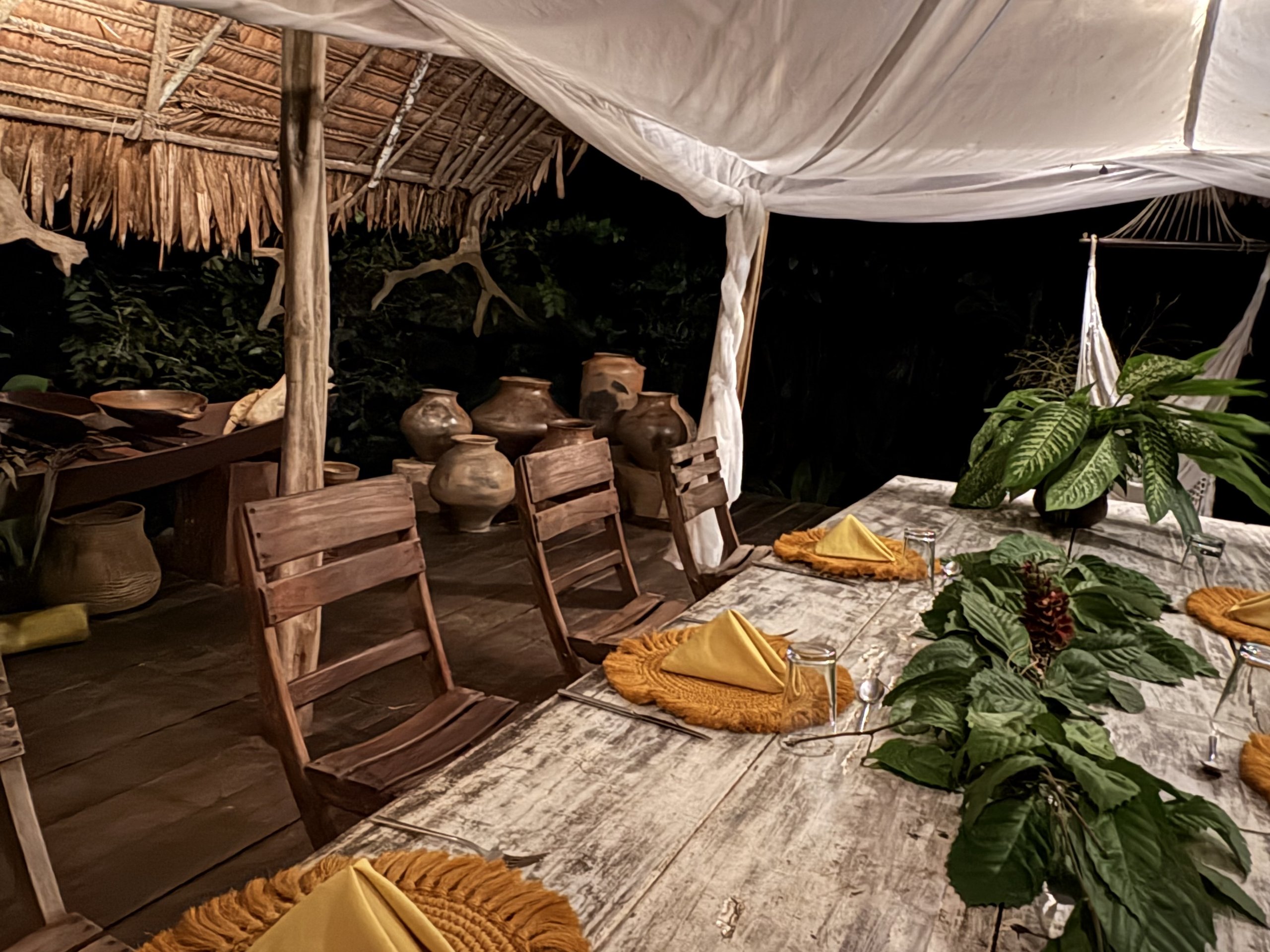
The dinner table, before the grasshoppers chose a side.
Diana's summary became the trip's motto: this is the epicenter of not controlling. You cannot control for mosquitoes in the Amazon. The same principle that explains the missing police station explains the dinner table: take out the institution that promises control, and what's left is not chaos but equilibrium — and people who insist on control anyway are not just unhappy, they're dangerous. That family, unable to observe anything through their own upset, wasn't watching for snakes, wasn't watching for anything. Out here attention is a survival skill, and the staff's waiting-on-you-hand-and-foot is a paper-thin layer over a place with no layers.
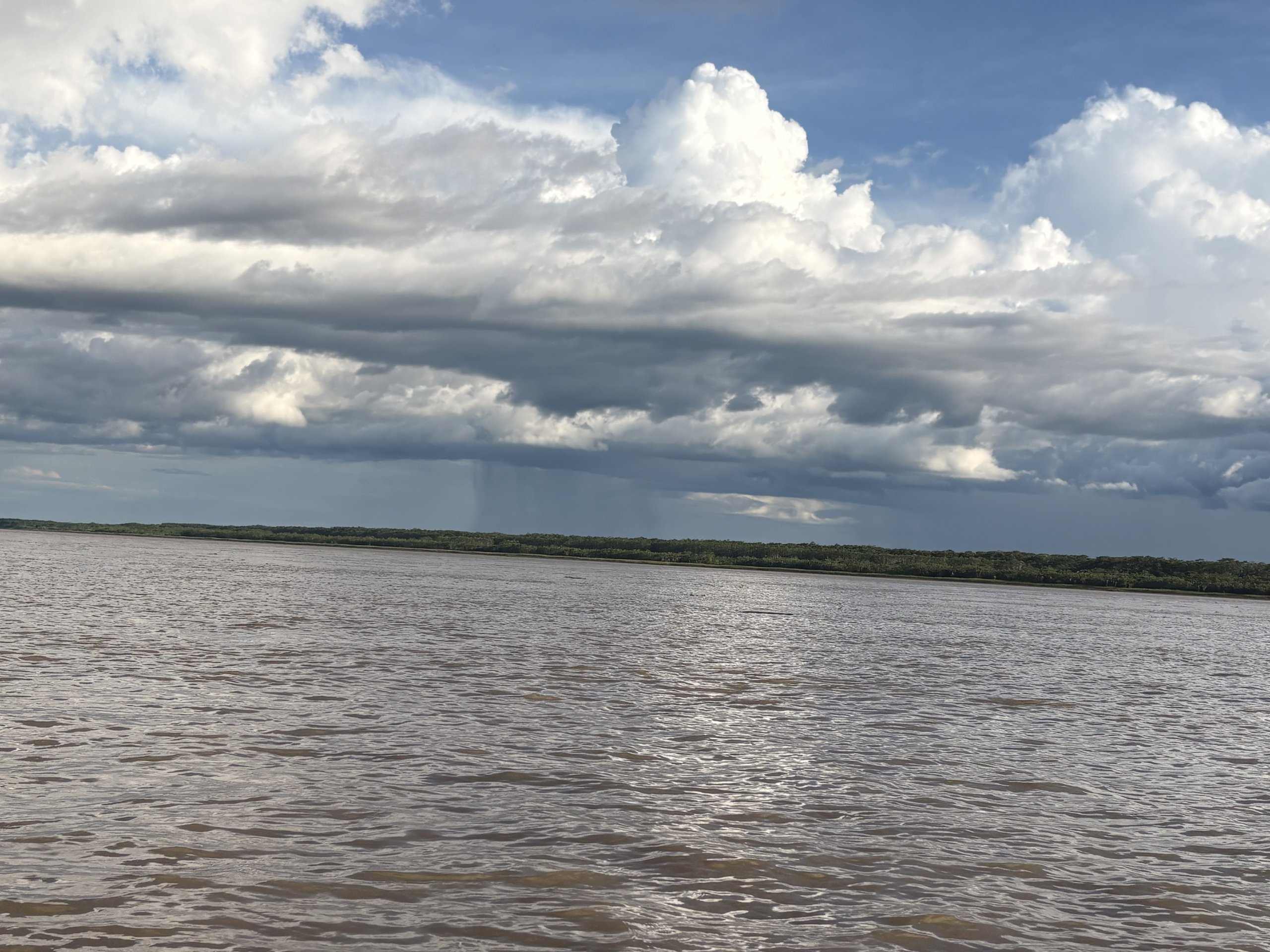
Rain walking across the river. You cannot fight that force.
The forest, for its part, had opinions. Cockroaches found their room nightly; we heard the screams. On their final evening, their table — theirs specifically — was invaded by grasshoppers, dramatically enough that dinner had to move indoors. Afterward one of the ladies cleaning up remarked, in front of us, that the family's bad energy had brought the pests. And later, once we were home, Gloria sent Diana a beautiful message thanking us for our good energy — it was our good energy, she said, that had attracted all the animals we saw. Put those two statements together and you have the local theory of the forest: an actor with agency, who responds to your emotional state, rewards good vibes and answers bad ones with grasshoppers. Superstition, sure. Also, we'd argue, an accurate worldview. You cannot fight that force. Torrential rain to raging river, it is a beast, and whether it wants you there is a perfectly reasonable question. Diana grew up hearing her parents say exactly that about the Amazon: the forest wants somebody here; the forest does not want somebody here.
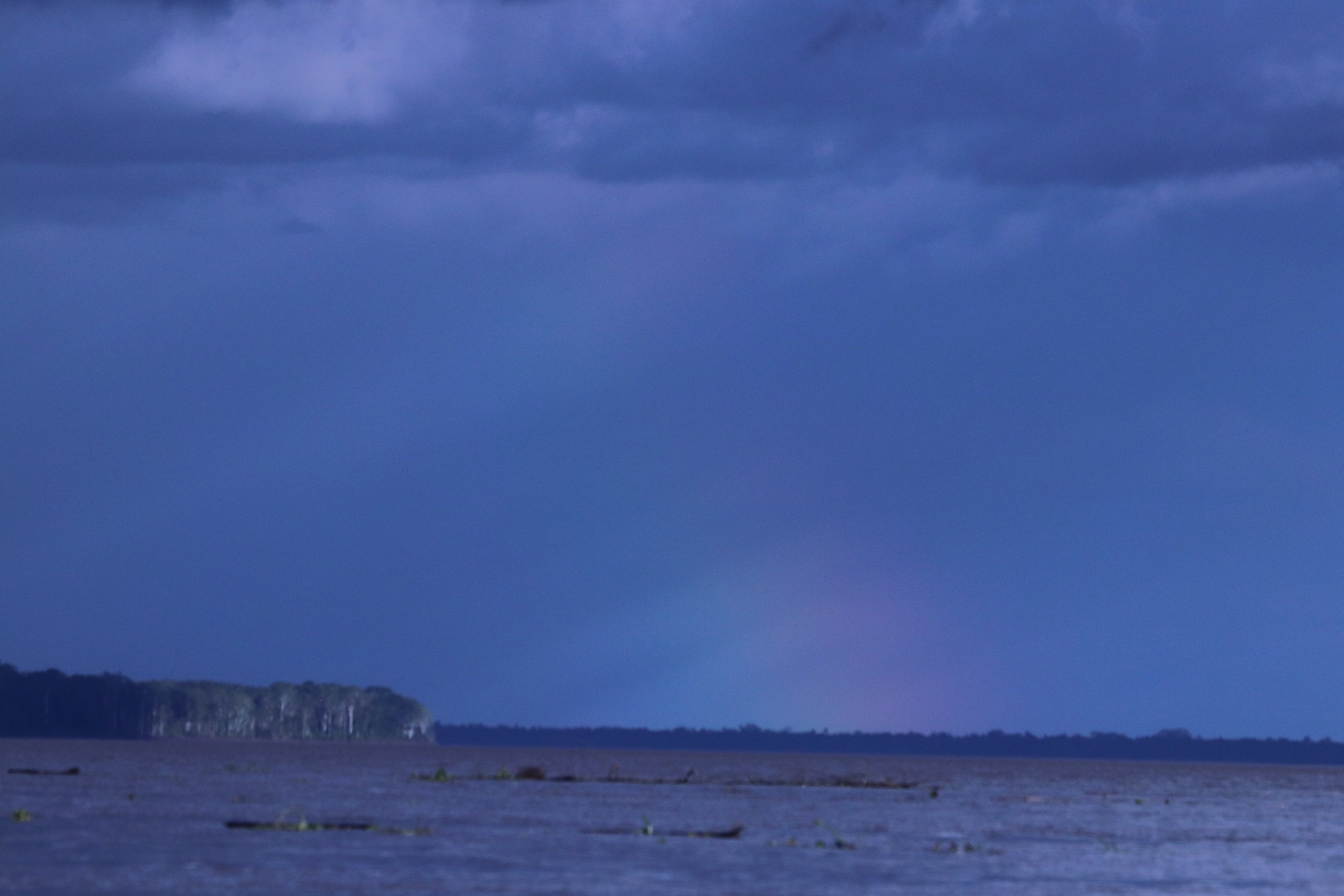
The storm sends a rainbow anyway.
Armando and the Swallow Tree
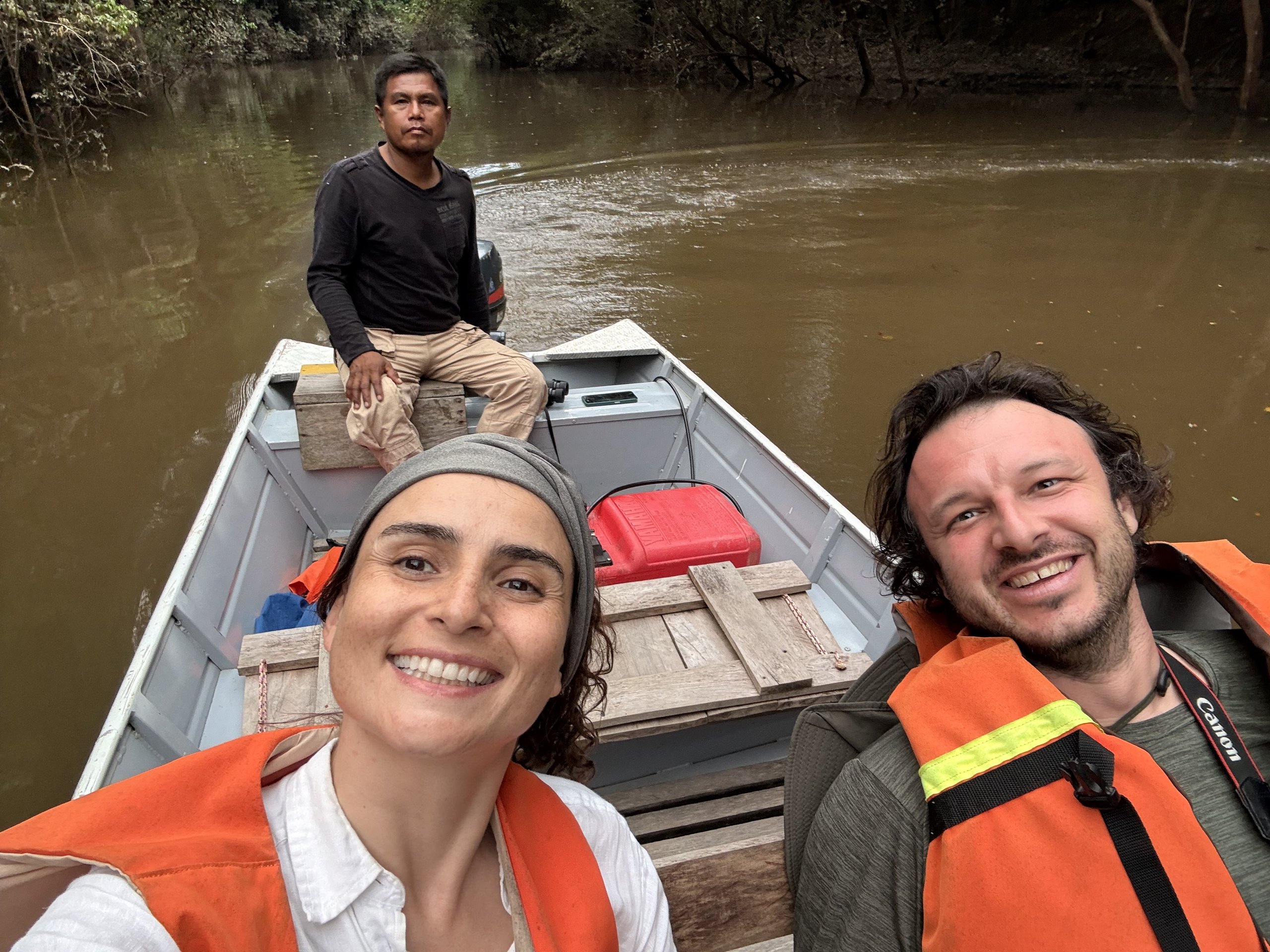
For the first days Armando was just the driver — we could have had anybody as a driver. Then Gloria had to leave, and we re-met him. It turned out our boat pilot was a researcher: part of a group doing primate monitoring, loaded up with Merlin, able to do bird calls, in possession of the locations of huge quantities of birds. He makes eight-hour inland hikes to a wall where red macaws gather. Freddy, another of the guides, had told us early on that this group — based in the community, publishing through the national parks — had discovered two new species of birds in the area.
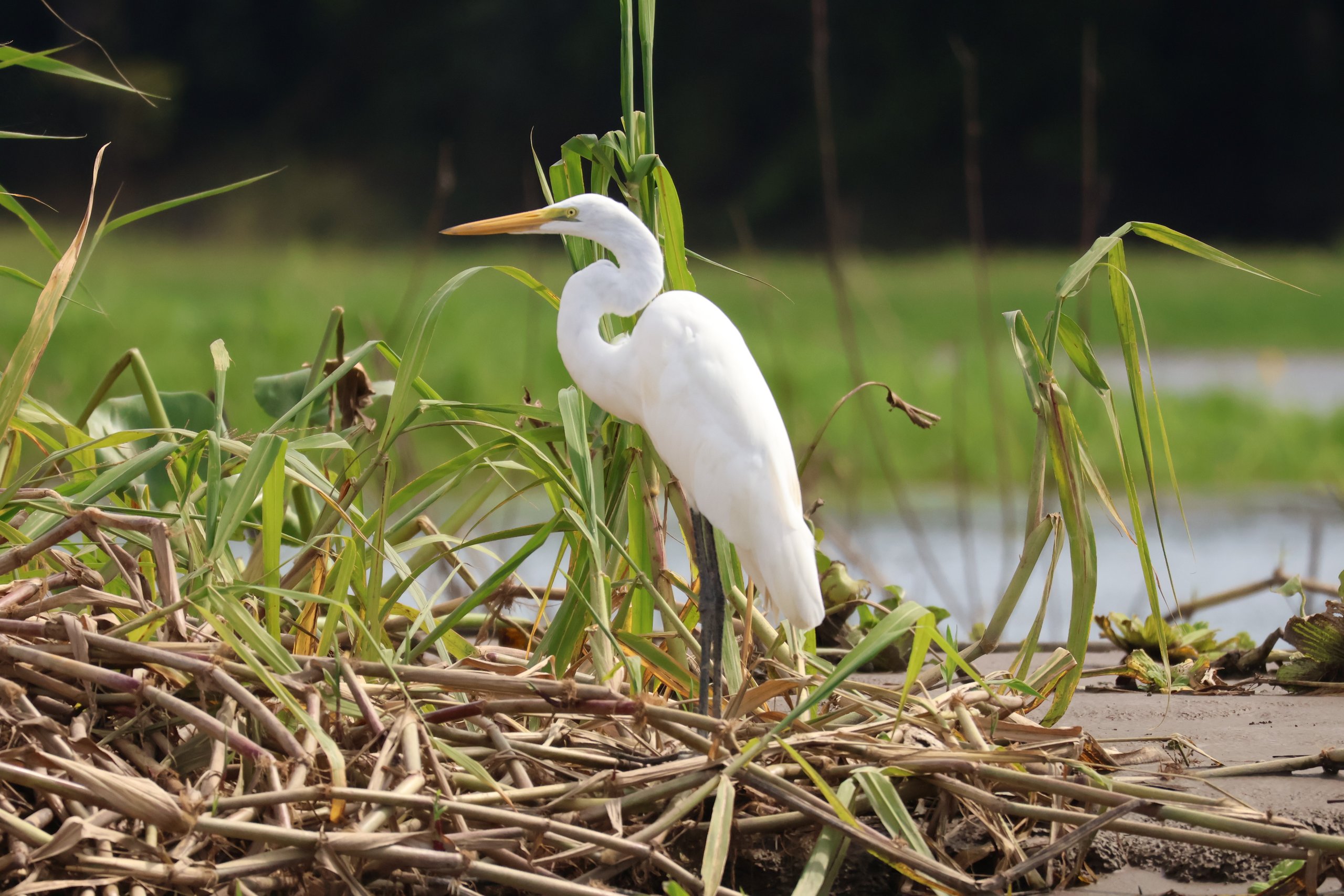
The great egret, B908 — Armando slowed the boat before we asked.
Sit with that combination for a second, because it may be the most remarkable thing on this river: people who inherited indigenous knowledge of the forest from infancy — who navigate death by a million different bites as a childhood curriculum — and who are also working scientists. Both forms of knowledge in one person. There is no way to acquire that from outside; you were born navigating this place or you weren't. You cannot hire a teenager out of Bogotá for a summer and have them move people through this forest. Absolutely no way. Which means Calanoa — which means all of it — runs on indigenous ways of knowing or doesn't run.
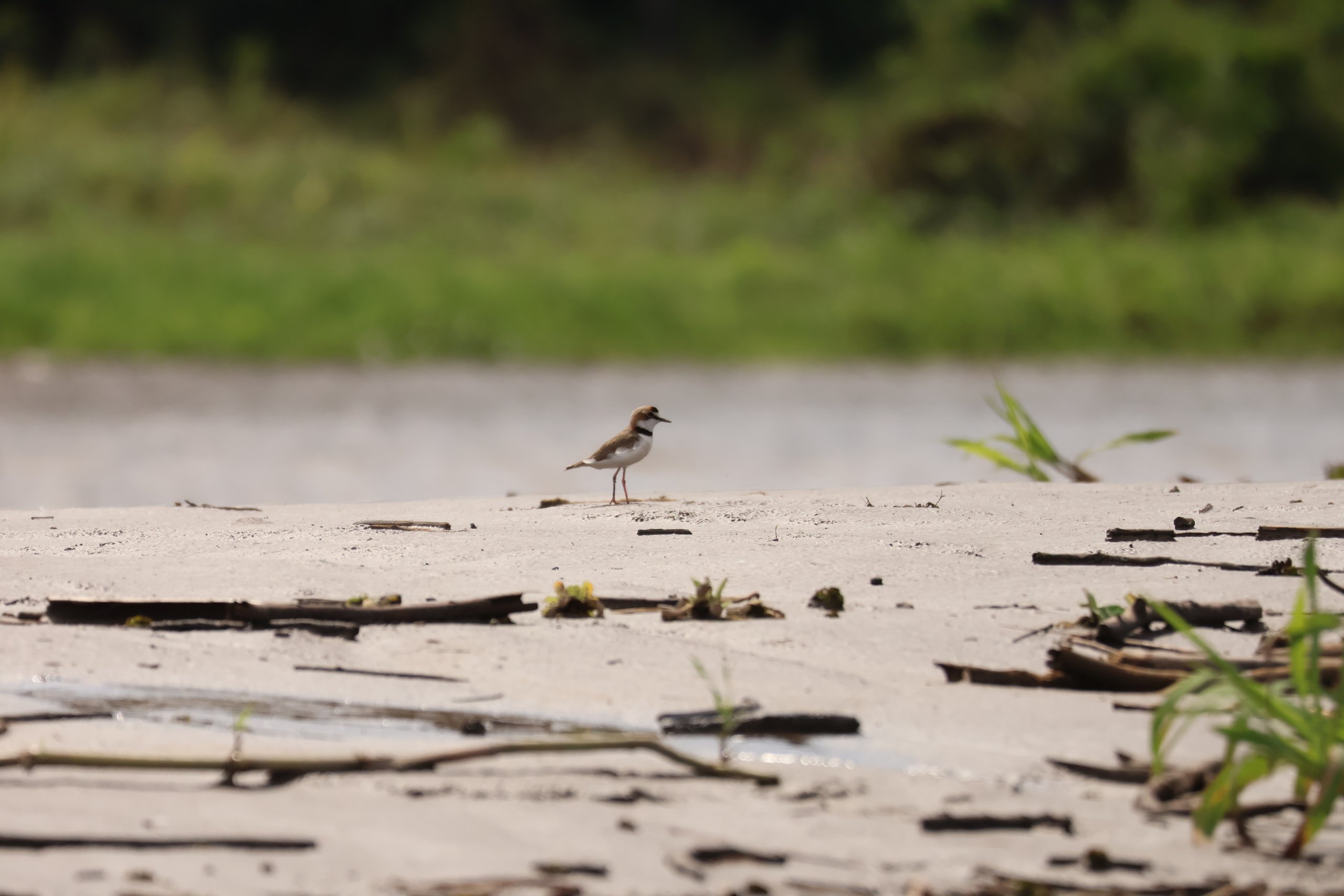
The collared plover, walking the beach beside it.
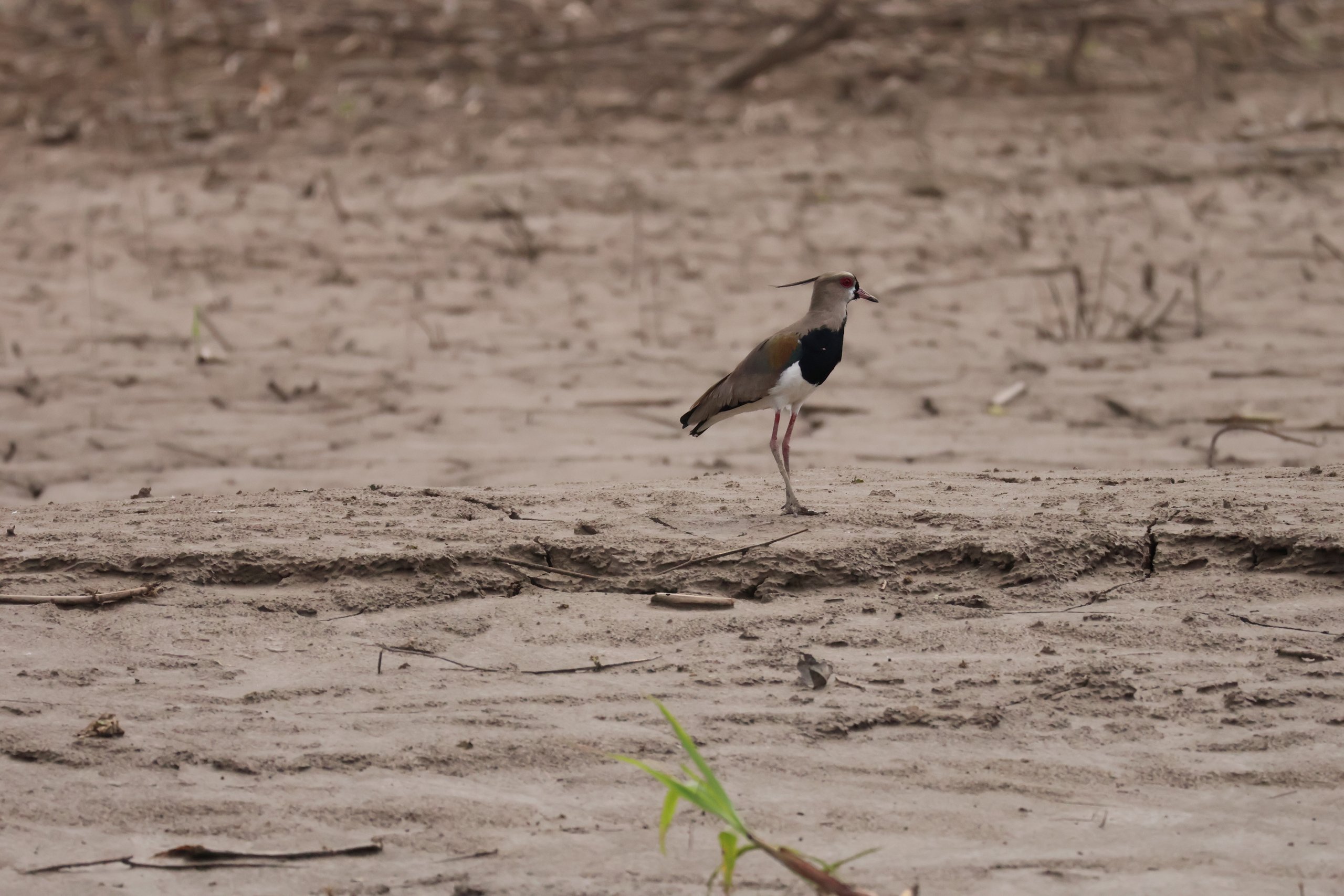
With Armando the trip turned into a bird processional. He slowed the boat for a heron before we'd even left the dock, then argued happily with Gloria about a tiny bird on the beach — the collared plover, as it turned out, walking near a great egret. He stopped for Colin's favorite bird, the southern lapwing — the little weirdo with the hairdo, quero-quero in Brazil, knives hidden in its wings. On the last full day he took us around Mocagua Island, more than ten species in a single morning, and then came the tree.
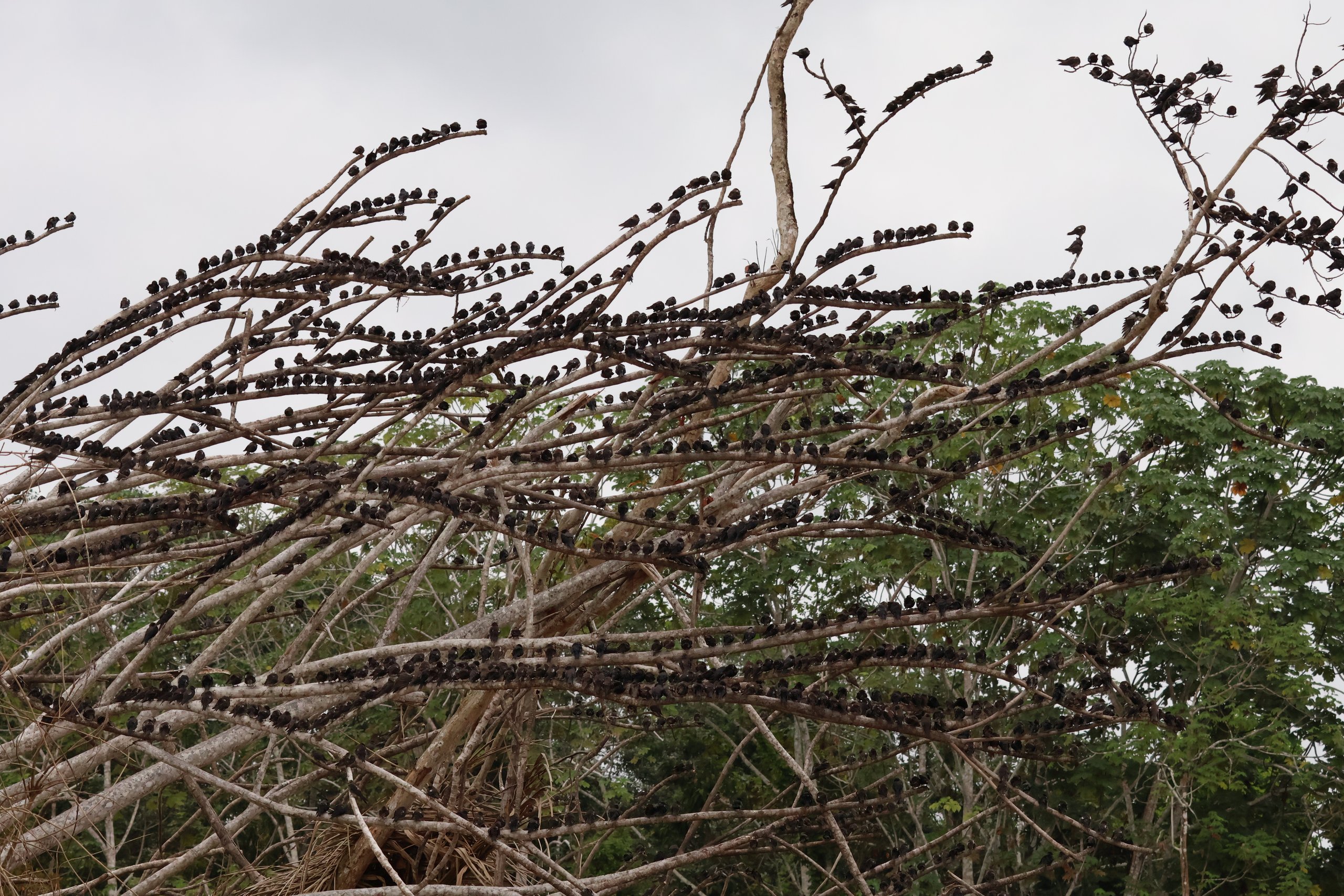
The little weirdo with the hairdo: southern lapwing.Every branch lined with little black dots. Not seeds.
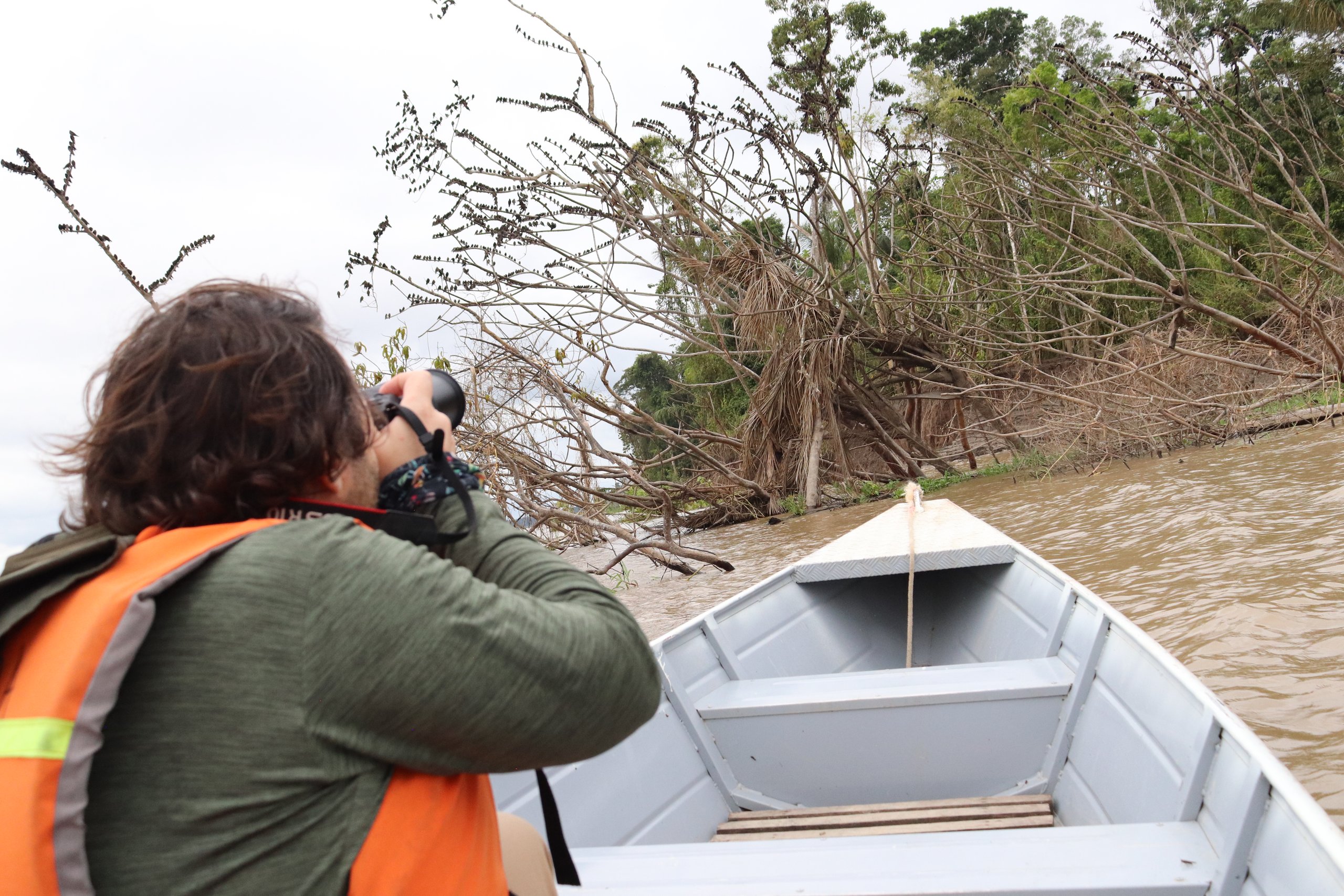
A dead tree had fallen into the river, bare branches sticking out of the water, and every branch was lined with little black dots. Seeds, Diana thought. Then we got closer and every dot was a swallow — hundreds of them, maybe more. Armando drove the boat right under the branches, revving the engine, throwing sticks at the trunk, making hawk calls, absolutely delighted, and the swallows lifted off in waves, circled us where we sat in the middle of the river, and settled back, branch by branch. It happened twice. It was completely beautiful, and the joy of sharing it with someone who had seen it a thousand times and was still throwing sticks — that was the gift.
The swallows — martins, properly — circling the boat.
He also called Diana "Gloria" the entire time. She never corrected him. Somewhere on the river, Armando is still telling people about his lovely day with Gloria.
The bird processional, seen from the stern.
Teresa's Village
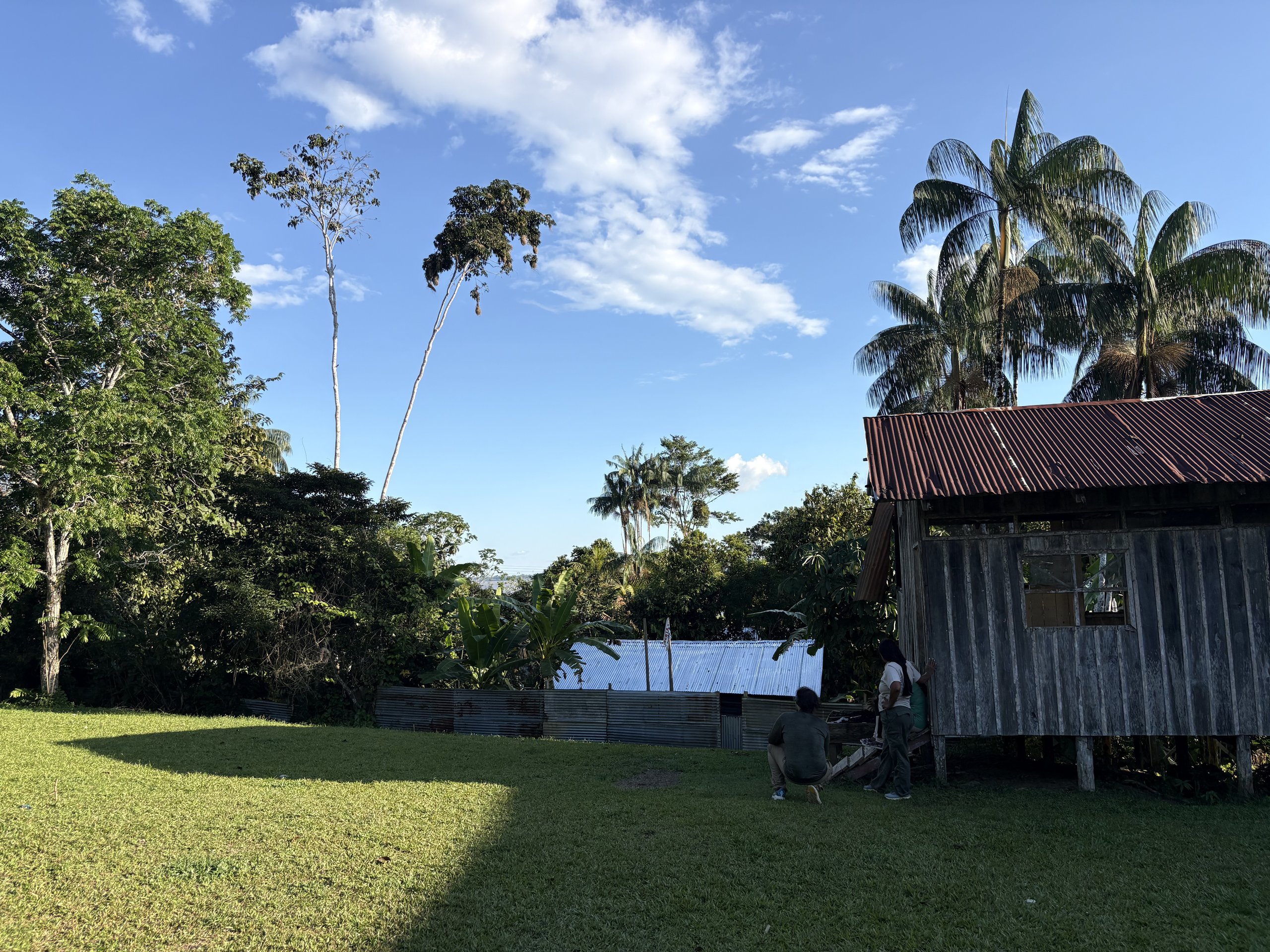
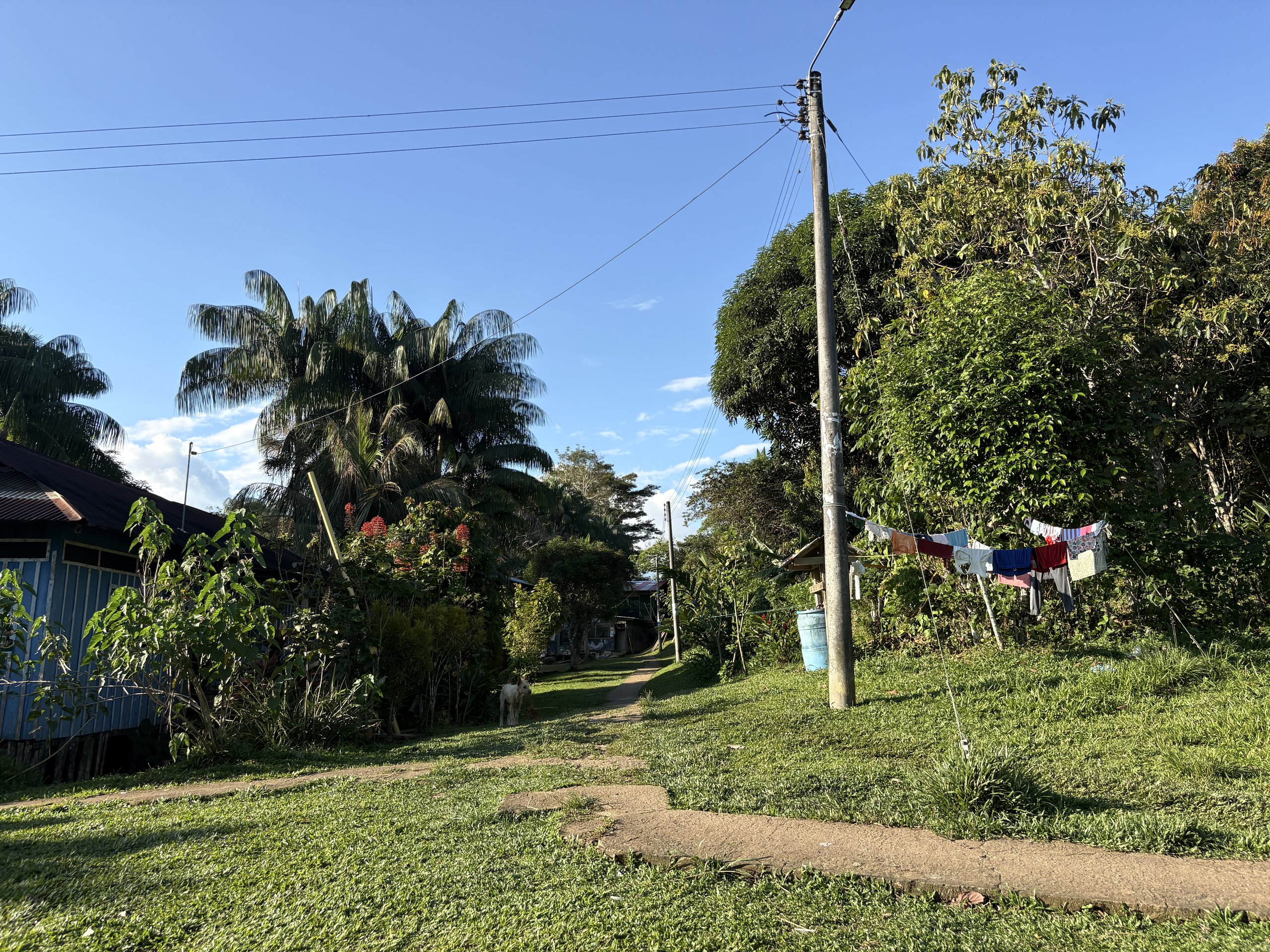
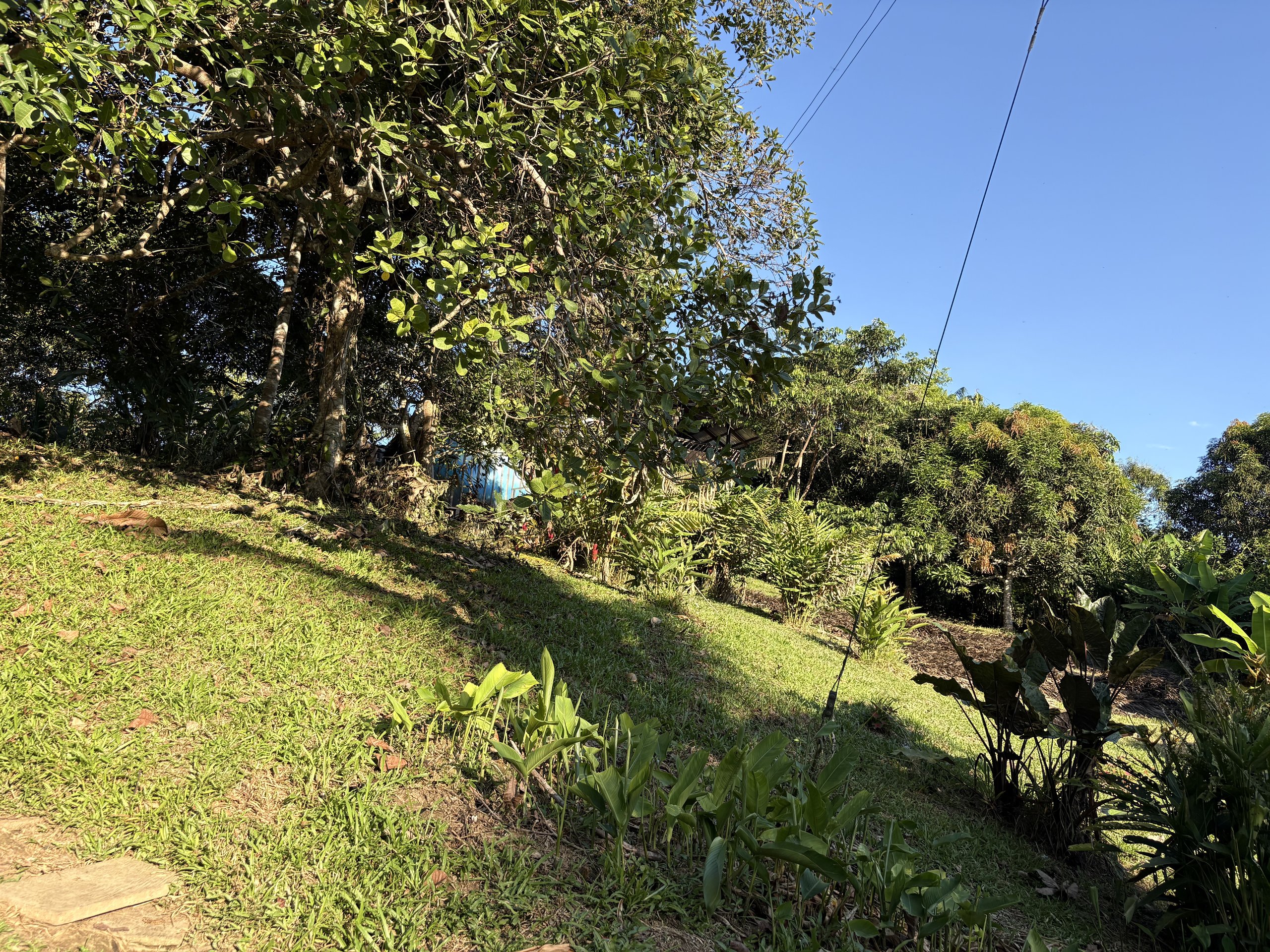
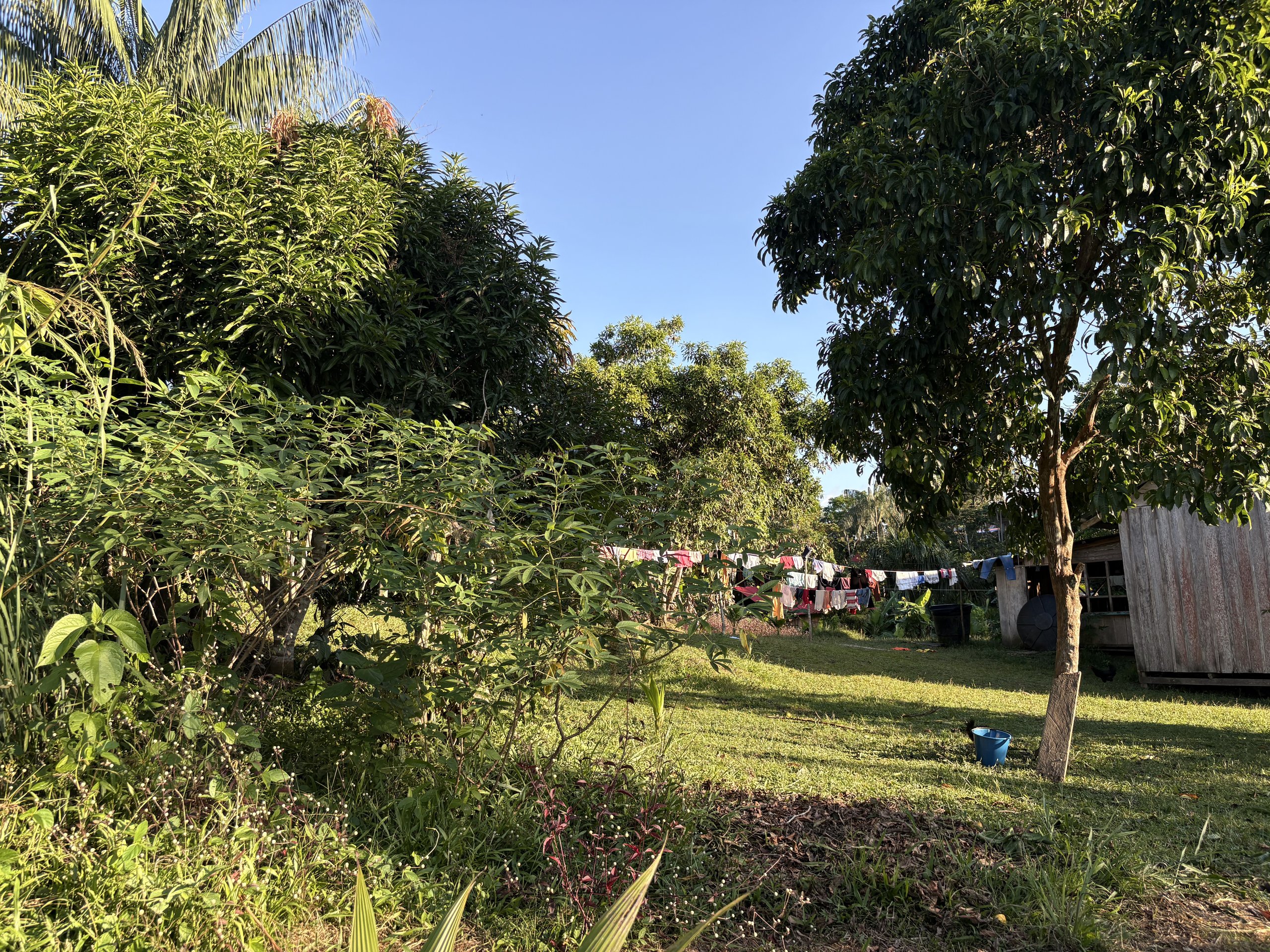
We asked, one evening, whether we could go look at birds again, and the machinery of the place turned quietly: someone was mobilized from the village, and out came Teresa, in her Calanoa shirt, totally lovely. What was billed as a birding tour became a tour of her life. She brought us to her home, introduced her grandchildren, and showed us a bucket of parakeets she was raising. She walked us through the town — Mocagua, same name as the island, home to five indigenous communities of which the Ticuna are the largest — with its measured sidewalks (visibility: snakes, mud), its beautiful wooden houses, gardens, flowers everywhere, a town out of a storybook. There are general stores stocked with rice, beans, gasoline; there are so many chickens; there is a school. The town gives out land the old way: you ask the president — Teresa's word — and a town assembly decides. She walked us over a hill into an entirely new neighborhood, four houses overlooking a valley with the river behind it, palms and lush green and flowers of every color, and both of us thought the same thought at the same time: could I have a house here? Her parents-in-law question, Diana's parents' question. The one they actually answered, once, for a year — which is the entire reason we were standing in that valley.
Teresa's town: stilt houses, mango shade.
In the artesanía store a woman taught Diana to say thank you in Ticuna — moinchi — and told us about the blowguns. They keep one of the old hunting cerbatanas around, and they make toy ones for souvenirs, and she told us about a little boy from the States whose father bought him one; the first thing the kid did, the moment it touched his hands, was shoot his father in the neck with a dart. Harmless. Immediate. They asked whether we would ever bring the boys, and Diana said yes, we would like to.
Laundry line between mango trees.Over the hill toward the new neighborhood.
At the end of the tour Teresa stood there in her Calanoa shirt and said: come back, come stay in my home. Come back to the Ticuna — don't go to Calanoa. How much professional boundary is there when the birding guide brings you to her grandchildren and then bids against her employer? The truth is there isn't really a layer out here. The Ticuna enabled all of it — the lodge exists because they allow it, staff it, guard it, guide for it — and Calanoa draws a social shape almost in clay on the sand and asks everyone to stand in it, temporarily. Teresa was simply pointing at the sand.
The maloca museum, and a tree of fruit.
One Four-Thousandth of a Second
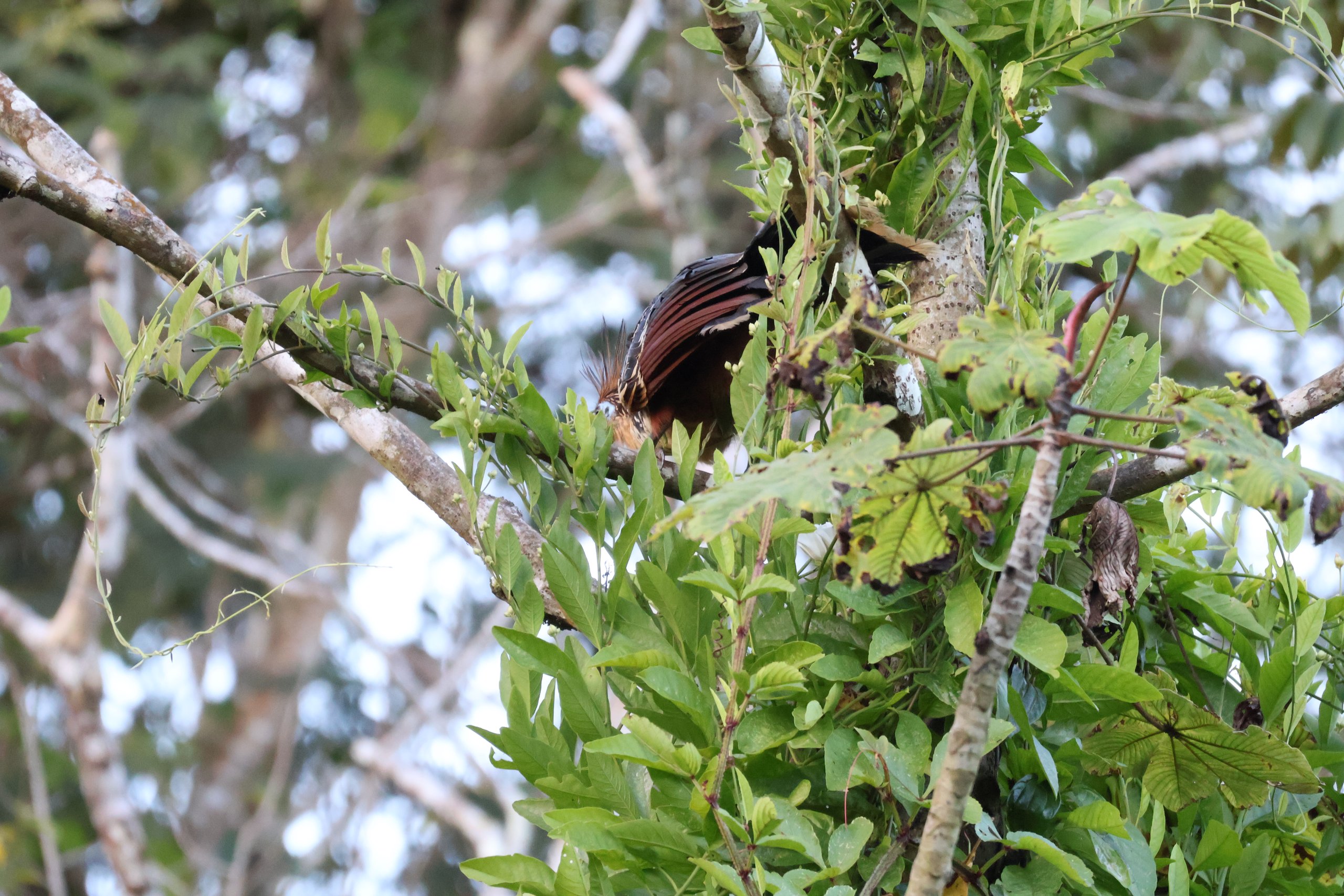
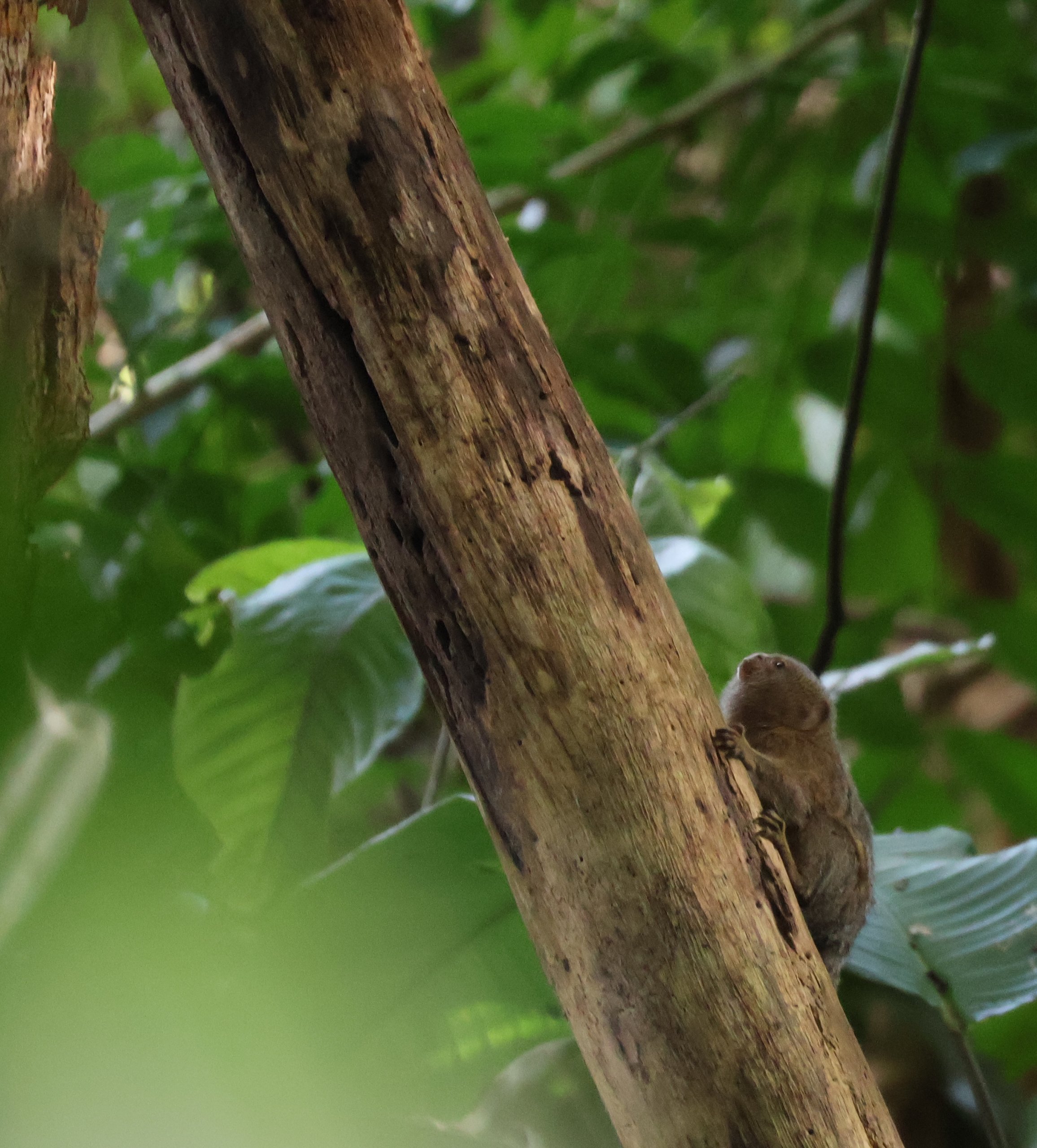
Colin hadn't spent this much time behind a camera since high school. The Amazon is a firehose of subjects — two iguanas outside the room, wasps, bats, sloths, a black tamarin, galloping caterpillars, hiding monkeys, a pygmy marmoset (three hundred grams, briefly in our hands), a vulture charging itself in the sun like a solar panel, a hoatzin — the stinky turkey, which Gloria says is about as close to a pterodactyl as the modern world offers — and, by our loose count, over a hundred kinds of birds. The density changes what photography is. You're not looking for a subject; you're triaging them.
The apparatus, deployed from the deck.The kingfisher of «felicitaciones».
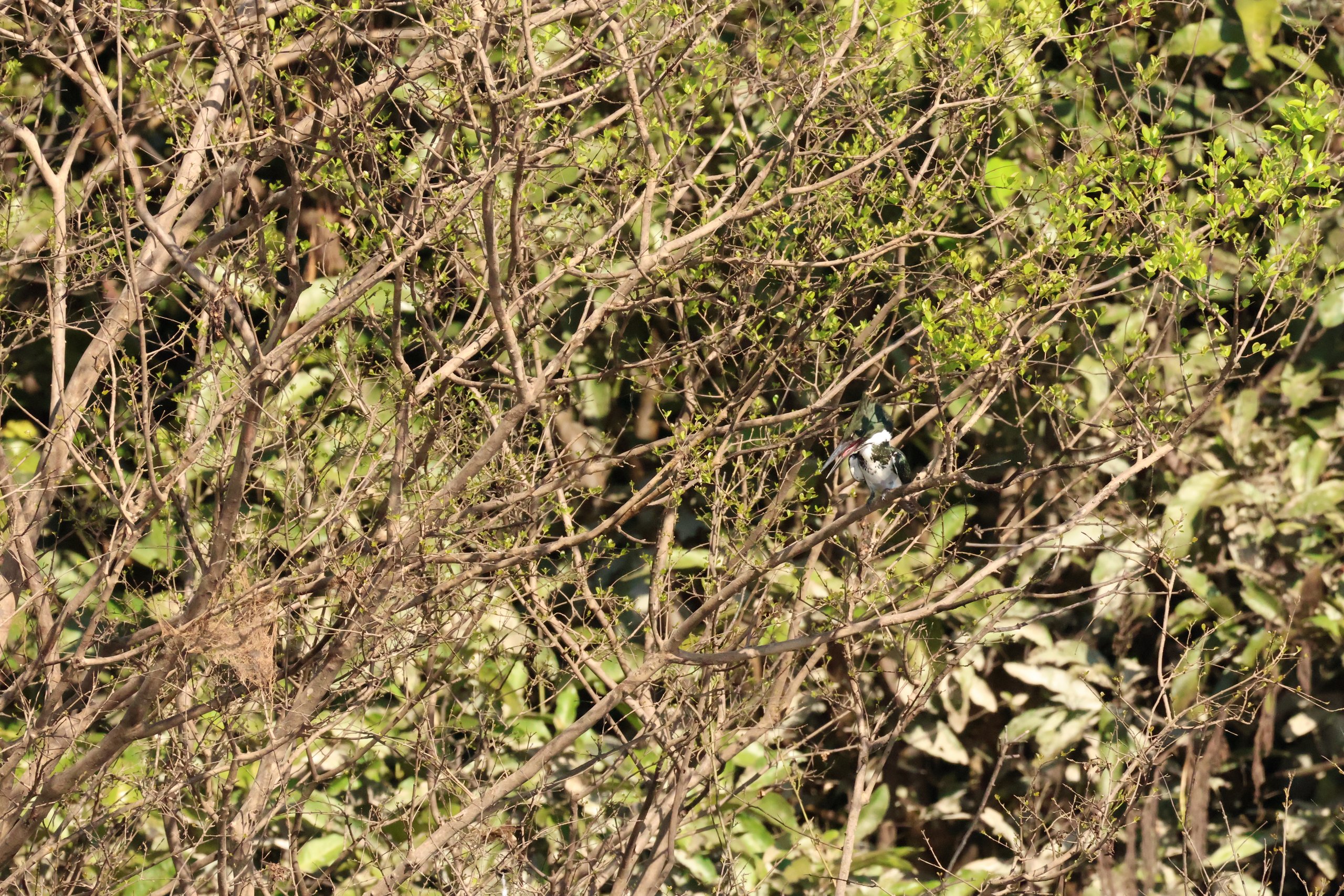
The week became a course in speed. This camera will shoot at 1/4000th of a second — catching a speeding bullet, basically — and the last lesson of the trip was to trust it: whenever there was direct sun on the bird, 1/4000 was the right answer, and fear of darkness was usually wrong. Then there was the kingfisher — a small, rare kind, Gloria lit up about her — who sat on a branch a long time and then gave us a dive, a pterodactyl silhouette coming up off the water, feathers reflected in it. When Gloria saw the shot she said one word: "Felicitaciones." That word is going on the wall.
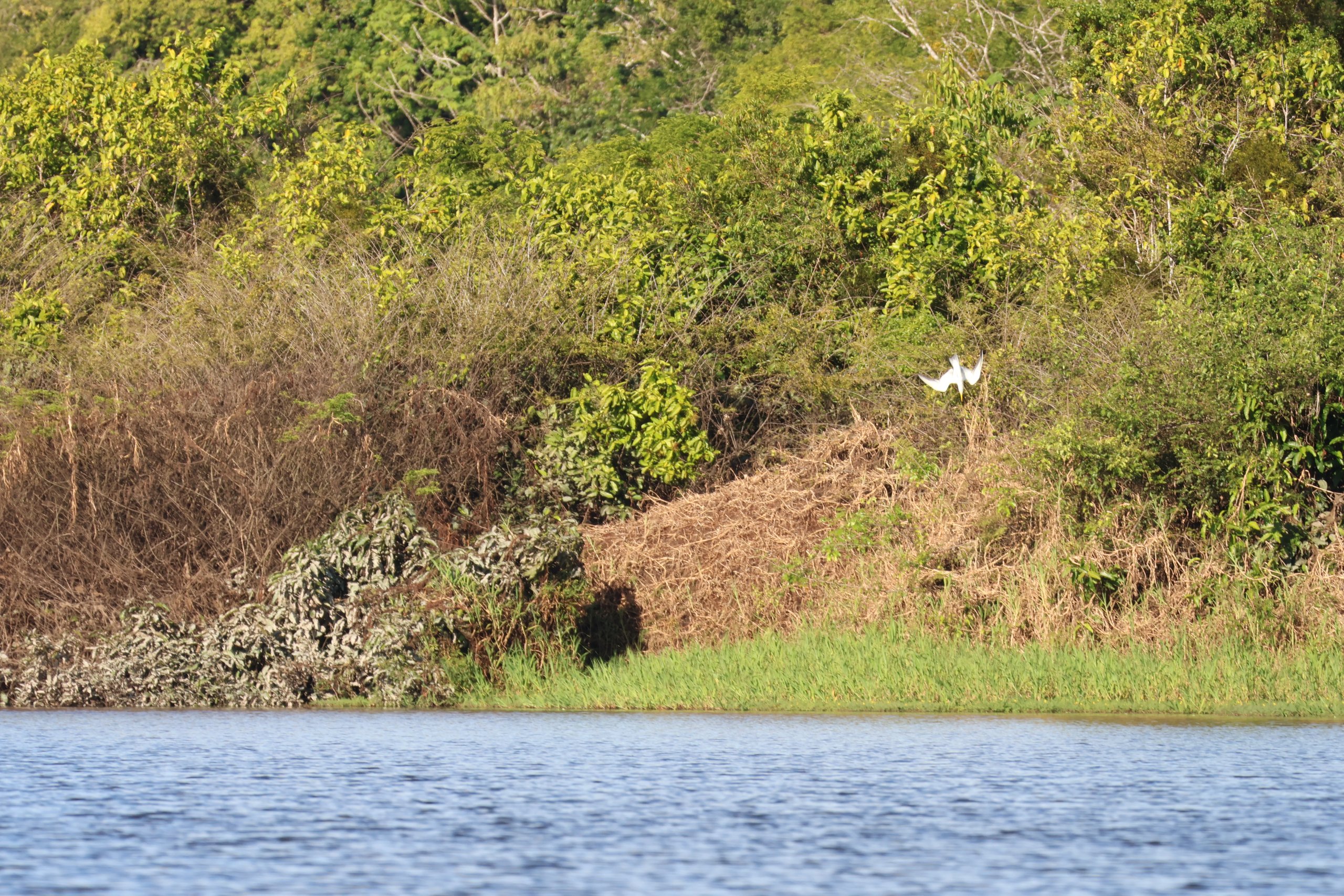
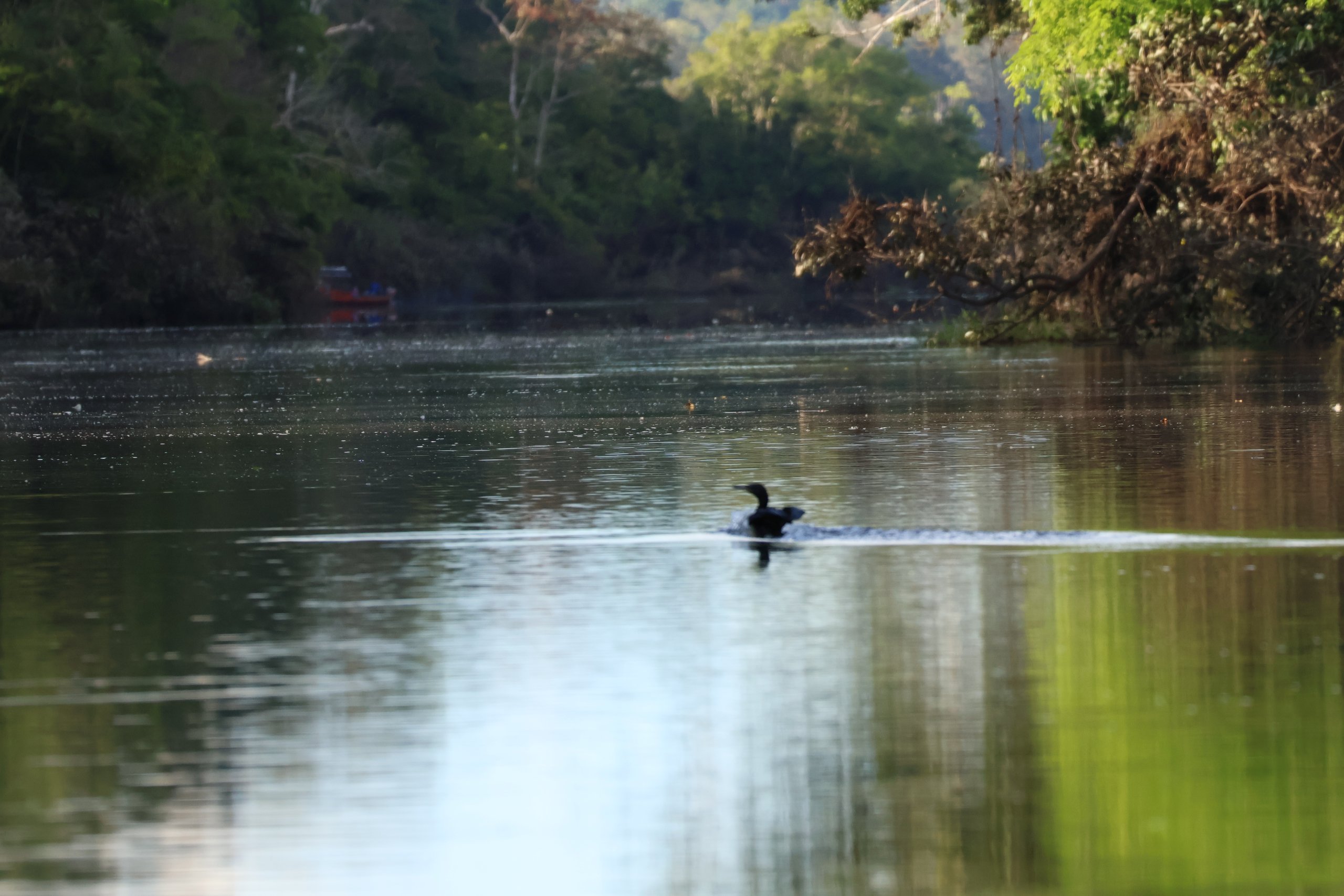
A large-billed tern, mid-argument with the river. The cormorant we personally disturbed six times.
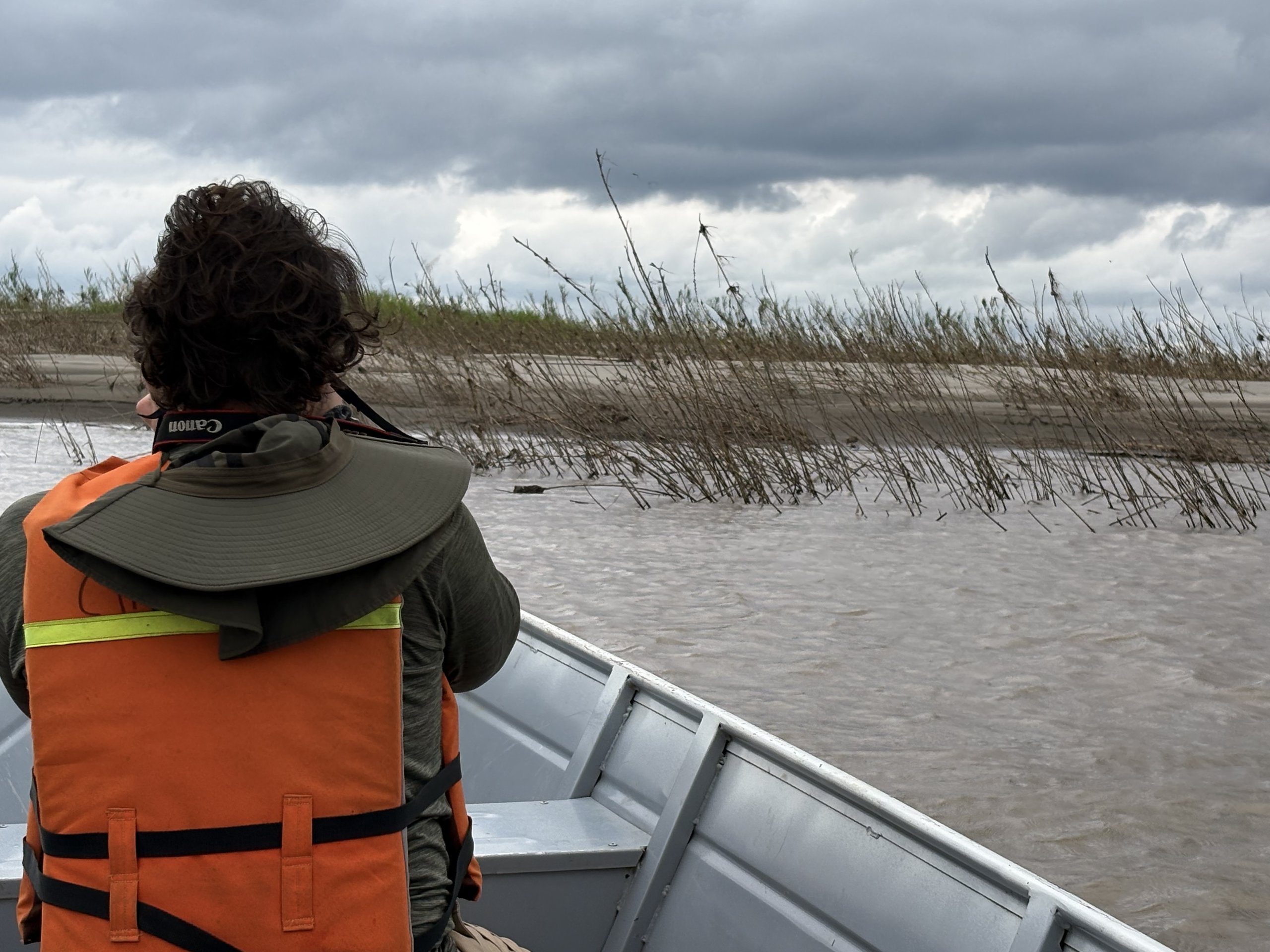
The final exam was flying birds on manual focus. It takes a very specific wiggle: aperture and shutter already zeroed, hand on the ring like it's second nature, and when a cormorant — a cormorant we had personally disturbed six times, that poor guy — comes flying toward you, you overshoot, undershoot, dial back just short of focus and burst, and the bird flies through the focal plane at 1/4000th of a second. One frame in ten is yours. There's no other way to do it. By the last day, terns were diving into the frame with the splash frozen mid-air.
Hoatzin: the stinky turkey, nearest living pterodactyl. Pygmy marmoset. Three hundred grams.
The River Gives
The river drops ten meters in these months, and what it leaves behind is the oldest scene in the world. The banks come up out of the water as fresh, fertile silt — alluvial is the word — and the people plant them, immediately, in real time. Yucca goes into ground that the river fertilized and watered on its way down. No irrigation, no fertilizer: the water came to them, the nutrients came to them, the Nile dropping on a different continent. Watching the Amazon turn into farmland at its own retreating edge felt ancient in the exact, literal sense. It does not get any older than that.
A stilt house with a solar panel: the whole economy in one frame.
Around that seasonal pulse the local economy is elegantly small: subsistence fishing (there is always another piranha), chickens — chickens are the backbone of the whole thing, the way they were on San Juan Island; you cook a chicken, you eat for days, the whole farm gets used — plus tourism money for the things the forest doesn't provide, which round to gasoline, rice, beans, and oil. Families here had eight, ten kids; most went to the cities. The ones who stayed have a relaxed affect that is hard to describe and impossible to fake — pretty one with the forest, living inside a seasonality with no foreseeable change, and apparently at peace with that. It was very deeply moving. And conservation has settled in alongside it: thirty years old here, and everyone we met is invested. The math is stark — an animal is a hunting resource for two people or a renewable resource for millions of visitors who look at the sloth, leave footprints, and go home. Gloria does reforestation with the communities; the government added incentives at some point, and she was clear about the order of events: it's great, but they did it anyway, and they'll keep doing it without the incentive. Hunting is forbidden in the forest now — except for the indigenous communities who live inland, and when Diana asked whether they have special permission, Gloria's correction was quiet and pointed. "They have a right." Not an authorization. A right. Nature and man, without the mediation of the state.
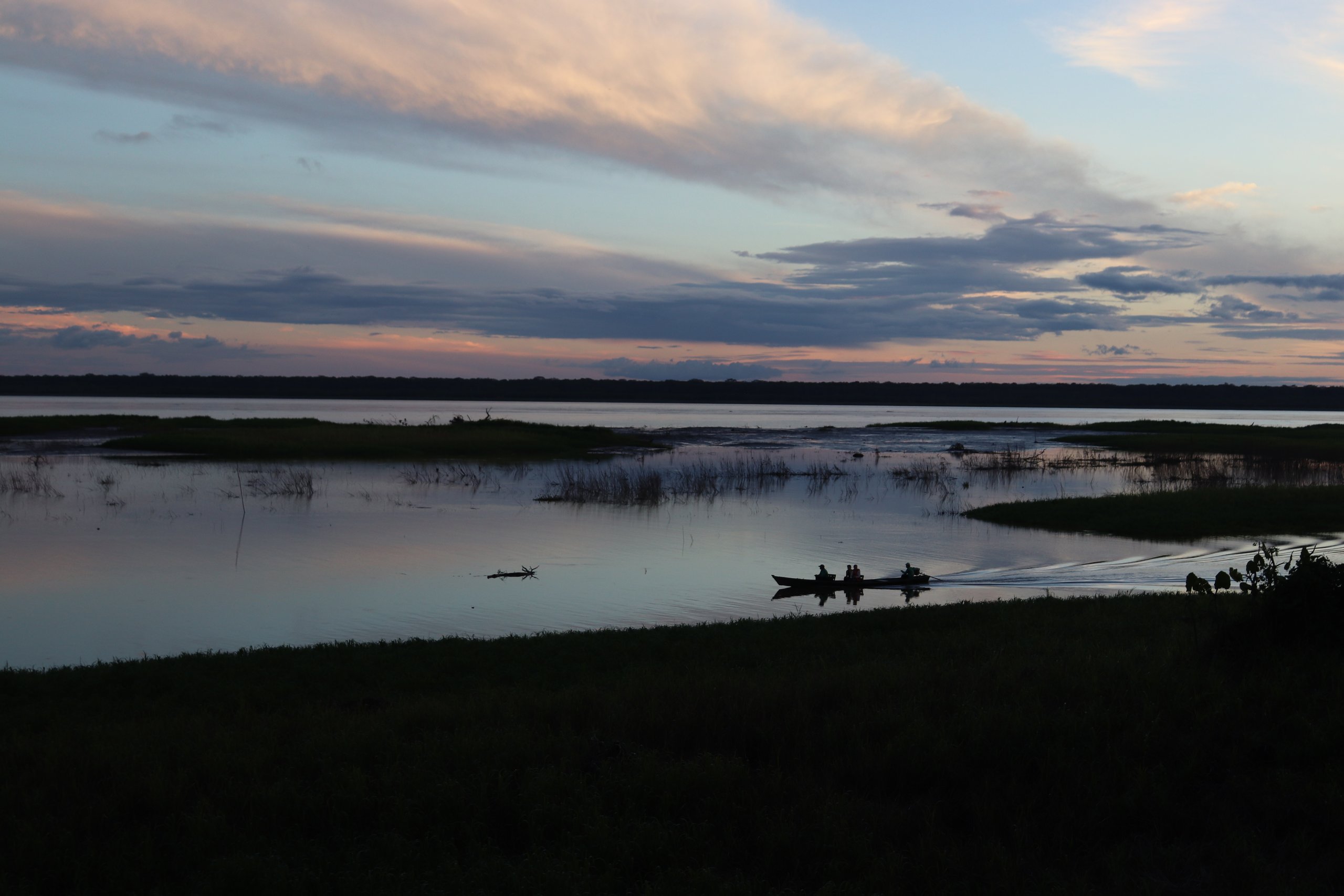
Crossing the wetland at dusk.
One afternoon we passed five canoes running upriver, loaded past any sane waterline with what could only be described as an entire discotheque. Speakers, lights, the works, about to sink, headed somewhere upstream to throw a party. A modern Fitzcarraldo. Life finds a way.
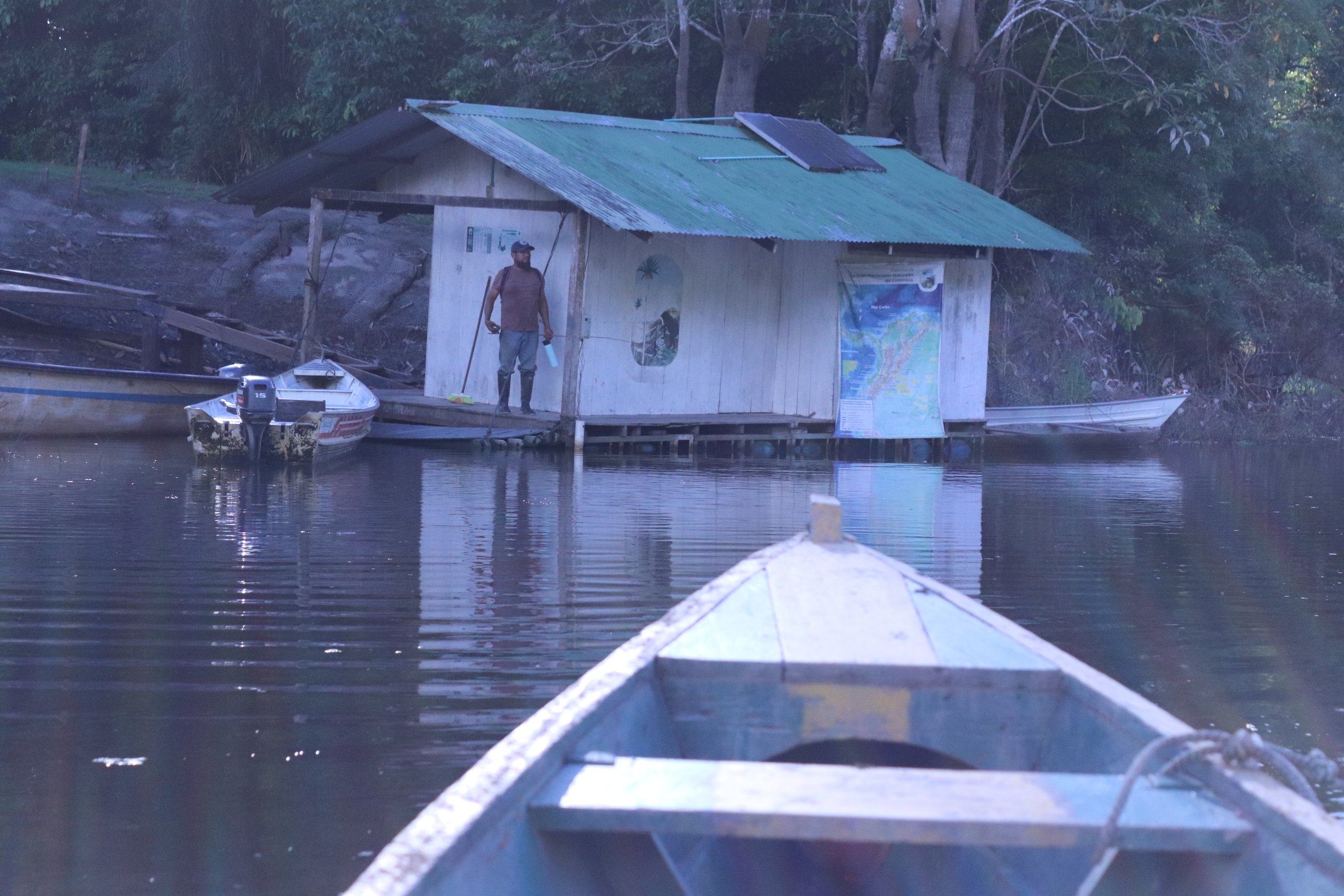
The landing: gasoline, rice, beans, and everything else arrives here.
Leaving
The last morning, while Colin waited on the dock, macaws crossed over it in flight, and he took some of the best frames of the trip as a goodbye. Then ninety minutes downriver to Leticia, during which the jungle arranged a farewell: gray dolphins jumping clear of the water, whole bodies in the air, on the left side of the boat.
Last morning on the water.
In Leticia we hunted down chuchuasa, the traditional liquor Diana's family loves. The man who made it in her parents' era died ten years ago and his wife let the business go, but the person we asked remembered him — the Amazon keeps its own records. We finally bought some at the airport, where they decanted it into a plastic Coke bottle, and Diana carried it home like that, with appropriately managed expectations. It's what the family asked for; it's what the family gets.
Calanoa from the river, going.
Diana left our unused water-purification tablets with the hotel. Bella from the staff was delighted — dry season was coming, and she said she'd distribute them among the ladies in the kitchen. It felt right that the last transaction was that one.
Then a hotel in Bogotá, bathrobes, a hot-water bottle, a room that did not contain a single thing that wanted to bite us — and the strange vertigo of a place where a teenager behind a desk can run everything, because if they mess up, the worst case is a missed flight. We sat there doing what you do after the Amazon: counting the ways it could have killed us and didn't, and understanding that we'd only stood in the threshold. Twenty lakes, uncontacted tribes further in, an entire universe — Amazonas the country — behind a door we'd barely opened. We told the woman in the artesanía store we'd bring the boys. Moinchi. We meant it.